Recent Movies

BBQ Roasted Salmon


Welcome back after the Memorial Day holiday weekend! I hope you enjoyed the last few days, regardless of wherever you are regardless of whether you celebrated or not. For us, we enjoyed time with friends over lots of great food. What did you enjoy over the weekend? It's the beginning of the beloved Copper River Salmon season and so I've been on a salmon kick lately. One of the things I prepared was this BBQ Roasted Salmon. This dish involves a marinade of pineapple and lemon juice followed by sweet and spicy rub over the salmon just before baking. All those flavors were absorbed by the salmon ever so perfectly and it made for a quick and easy dinner...

I've been wanting to do a BBQ salmon for awhile but the recipes I've seen involved a thick BBQ sauce which seemed to cover up or overpower the fish. In this recipe, the spices are an enhancement so that the natural salmon flavor still shines through. No worries though - you probably have all the spices on hand! Brown sugar, chili powder, lemon zest, cumin, salt and cinnamon are combined and then rubbed over the fish. This combination of spices can also be used on other fish like Tilapia or cod, or even shrimp!


I got this recipe through the Cooking Light website and its one of my favorite sites to try recipes from. With this summer season, I'm all for light, flavorful and healthier dishes that don't take a lot of time to prepare... and Cooking Light is full of them! I recently was asked by Cooking Light to join their Bloggers' Connection to share some of my favorite Cooking Light recipes. Joining me are some fabulous food bloggers and I'm thrilled to be among them!
For Cooking Light, food is above all a way into a shared experience that helps build family and community. We’ve reached out to a small community of bloggers who embrace similar values to join our conversation about the communal power of great-tasting, healthy food.

Each blogger brings a unique perspective, background, and style of cooking, making them valuable additions to the conversation around healthy eating. Check in with them daily, follow them through social media outlets, and join our conversation around the beautiful power of home-cooked food.

BBQ Roasted Salmon
recipe from Cooking Light

1/4 cup pineapple juice
2 tablespoons fresh lemon juice 
4 (6-ounce) salmon fillets 
2 tablespoons brown sugar 
4 teaspoons chili powder
2 teaspoons grated lemon zest
3/4 teaspoon ground cumin
1/2 teaspoon salt
1/4 teaspoon ground cinnamon
Cooking spray

Combine first 3 ingredients in a zip-top plastic bag; seal and marinate in refrigerator 1 hour, turning occasionally.

Preheat oven to 400°.

Remove fish from bag; discard marinade. Combine sugar and next 5 ingredients (sugar through cinnamon) in a bowl. Rub over fish; place in an 11 x 7-inch baking dish coated with cooking spray. Bake at 400° for 12 minutes or until fish flakes easily when tested with a fork. Serve with lemon, if desired.

A Focused Environmental Autism Research Strategy Is Needed


If you have a child who is severely affected by an autism disorder, whose ability to understand the world is limited, who wanders into dangerous traffic, lakes or rivers,  is prone to seizures or  engages in serious self injurious behavior autism is not just an alternative way of thinking or an opportunity to build a career mouthing empty feel good cliches about autism acceptance on twitter.  If you are a parent with a severely autistic child you will probably fight for evidence based autism interventions, accommodation in the schools for autistic students and a place for them to live with dignity as you grow old and ultimately die.  These are the harsh realities faced by  parents with low functioning autistic children who must look at autism seriously and not as an opportunity to tell the world that everything problematic about autism is solved if we all just accept autism in our child. For many parents we would like to see solid scientific research into all the causes and conditions that create autism in our children, genetic and environmental causes.

Autism may be prevented, treated or even cured in the future if the research is done.  If that research leads us to the age of the father in some cases then that is important to know. If that research leads us into the multitude of possible impacts on children while in the incredibly important environment known as the womb then that research must be done.  What will not help in understanding autism is simply throwing our hands up in the air and arguing that we should not conduct research on the prenatal environment or in mocking attempts to research possible environmental causes of autism as some Neurodiversity bloggers like to do.  

For many of us our child's Autistic Disorder is a serious, life impairing disorder, and a mystery  that must be solved by solid research, genetic and environmental. Environmental research has been short changed and a solid environmental research strategy is required as recently advocated by Philip Landrigan and his colleagues in A Research Strategy to Discover the Environmental Causes of Autism and Neurodevelopmental Disabilities. Landrigan and his colleagues Luca Lambertini and Linda Birnbaum of the Children’s Environmental Health Center, Mount Sinai School of Medicine, New York and NIEHS and NTP, National Institutes of Health, Department of Health and Human Services, Research Triangle Park, North Carolina.  

The distinguished authors argument includes a "proof of principle" segment in which they list studies linking various toxic substances to neurodevelopmental impairments:

"Exploration of the environmental causes of autism and other NDDs has been catalyzed by growing recognition of the exquisite sensitivity of the developing human brain to toxic chemicals (Grandjean and Landrigan 2006). This susceptibility is greatest during unique “windows of vulnerability” that open only in embryonic and fetal life and have no later counterpart (Miodovnik 2011). “Proof of the principle” that early exposures can cause autism comes from studies linking ASD to medications taken in the first trimester of pregnancy—thalidomide, misoprostol, and valproic acid—and to first trimester rubella infection (Arndt et al. 2005; Daniels 2006).


This “proof-of-principle” evidence for environmental causation is supported further by findings from prospective birth cohort epidemiological studies, many of them supported by the National Institute of Environmental Health Sciences (NIEHS). These studies enroll women during pregnancy, measure prenatal exposures in real time as they occur, and then follow children longitudinally with periodic direct examinations to assess growth, development, and the presence of disease. Prospective studies are powerful engines for the discovery of etiologic associations between prenatal exposures and NDDs. They have linked autistic behaviors with prenatal exposures to the organophosphate insecticide chlorpyrifos (Eskenazi et al. 2007) and also with prenatal exposures to phthalates (Miodovnik et al. 2011). Additional prospective studies have linked loss of cognition (IQ), dyslexia, and ADHD to lead (Jusko et al. 2008), methylmercury (Oken et al. 2008), organophosphate insecticides (London et al. 2012), organochlorine insecticides (Eskenazi et al. 2008), polychlorinated biphenyls (Winneke 2011), arsenic (Wasserman et al. 2007), manganese (Khan et al. 2011), polycyclic aromatic hydrocarbons (Perera et al. 2009), bisphenol A (Braun et al. 2011), brominated flame retardants (Herbstman et al. 2010), and perfluorinated compounds (Stein and Savitz 2011).

Toxic chemicals likely cause injury to the developing human brain either through direct toxicity or interactions with the genome...."

Landrigan, Lambertini and Birnabaum generated a list of 10 chemicals that they recommended as priorities for investigation.  They expressly stated that the list is not intended to be exhaustive but is intended to provide a strategic environmental research focus to catalyze new evidence based programs for prevention of neurodevelopmental disorders in children. The  list includes some very well known dangerous substances:

  1. Methylmercury (Oken et al. 2008)
  2. Polychlorinated biphenyls (Winneke 2011)
  3. Organophosphate pesticides (Eskenazi et al. 2007; London et al. 2012)
  4. Organochlorine pesticides (Eskenazi et al. 2008)
  5. Endocrine disruptors (Braun et al. 2011; Miodovnik et al. 2011)
  6. Automotive exhaust (Volk et al. 2011)
  7. Polycyclic aromatic hydrocarbons (Perera et al. 2009)
  8. Brominated flame retardants (Herbstman et al. 2010)
  9. Perfluorinated compounds (Stein and Savitz 2011).

Landrigan, Lambertini and Birnbaum recognize the importance of genetic research but, as other learned authorities have noted, genetic research has received the overwhelming share of autism research dollars. The recent IMFAR conference in Toronto left me with the impression that the "it's gotta be genetic" trend of channeling autism research overwhelmingly toward genetic research  is continuing. As these learned authors have argued so compellingly it is critically important that environmental autism research be focused .... and funded ... if autism disorders are to be prevented, treated or cured in future.

Madeleines al cioccolato

 “A scuola di cioccolato” Food Editore è una guida che non deve mancare nella biblioteca basilare di un’amante della pasticcera: la consulenza del maître chocolatier Omar Busi lo rende unico e meravigliamente ricco (e in questo momento anche particolarmente conveniente: trovate A scuola di Cioccolato su Amazon scontato!).

Coprendo l'intero spettro del lavoro sul cioccolato - dai fondamentali del cioccolato alle istruzioni sul design avanzato – A scuola di cioccolato è la guida più ampia e completa sul cioccolato attualmente sul mercato. Il libro illustra le informazioni di base sugli ingredienti, attrezzature e tecniche comuni per la cucina e pasticceria, offrendo allo stesso tempo chiare istruzioni passo passo su come creare piccole praline e grandi torte.

Composto da sei sezioni (A lezione di cioccolato, Decorare con il cioccolato, La colazione, La pausa caffè, Il dopocena, I peccati di gola), è completato da un utilissimo glossario, ideale per gli studenti iscritti ai corsi di pasticceria di cioccolato e dolciumi, nonché per i professionisti ed i pasticceri che a casa propria vogliono migliorare le loro abilità nel lavoro del cioccolato.

Illustrate passo-passo le istruzioni riguardano tutti gli elementi essenziali sul cioccolato, dal temperaggio alla creazione di ganache, usando stampi, spatole, termometri, pennelli e altro ancora.
 
Belle foto a colori diventano fonte di ispirazione nel mentre risultano chiare ad illustrare le tecniche base.

Da quanto ho in mano questo splendido libro ho avuto voglia di realizzare le madeleines al cioccolato, il risultato è stato meraviglioso, ma abbiate l’accortezza di realizzarle utilizzando solo 5g di lievito: io ho raddoppiato la dose ed il risultato ha compromesso parzialmente l’estetica, facendo venire alla superficie tante piccole bolle!


Per realizzare circa 30 madeleines al cioccolato vi occorreranno 150g di uova, 180g di zucchero a velo, 115g di latte intero, 285g di farina bianca 00, 25g di cacao amaro in polvere, 140g di burro, 30g di miele, 1 limone non trattato. 
Sbattete le uova con lo zucchero precedentemente setacciato e la buccia grattugiata del limone. Unite il latte freddo in cui avrete precedentemente sciolto il cacao e mescolate.
Aggiungete gradualmente la farina setacciata con il lievito, mescolate bene per amalgamare e unite infine al composto il miele con il burro fuso a bagnomaria o al microonde. Lavorare la massa finché risulterà liscia ed omogenea. Lasciate rassodare in frigorifero per 1 ora. Trascorso questo tempo riempite con un sac-à-poche gli stampini per madeleines in silicone della Pavonidea e cuocete in forno a 160° per circa 12’. Lasciate raffreddare leggermente e sformate.
 

Globe's New iPad Launch Party, Pricing Revealed

Globe is throwing a party for the official release of the new iPad on May 29, 2012. Globe will be offering the new iPad through their mobile internet brand, Tatoo.
The new ipad-adobotech
You can now apply for the new iPad on their Globe Tatoo website, Furthermore, if you wish to
Read more »

Samsung Galaxy S III on Smart’s Unli Data Plan 2000 FREE

Heads up guys! the Samsung Galaxy S3 has been available for pre-order from Globe and now it’s also available on Smart on their pre-order page. You can get this In your hands this June 2012

smart samsung galaxy s III-adobotech

Smart pre-order page says that Samsung Galaxy S3, phone is FREE on Smart’s Unlimited Data Plan 2000. While Globe is offering it for free starting on their Plan 2499.

Read more »

Google+ for Android: Updated with better Performance

It’s about time that Google+ is updated on Android platform. The update includes lots of highly-requested features—like the ability to start a hangout on the go, and to edit posts inline—as well as a stream that celebrates the rich content shared across Google+.

googl  new.adobotech googl .adobotech

The details of Google+ Android app offers:

Read more »

JULIA CHILD’S COQ AU VIN & CHOCOLATE MOUSSE CHARLOTTE

A SET OF MASTERING THE ART OF FRENCH COOKING


Cooking is like love; 
it should be entered into with abandon or not at all. 
– Julia Child 


We were poles apart. She strode across College Green with all the confidence of someone who has always been the star of the show, the darling of those who raised her while I, hiding my face behind a wall of bangs, rushed across campus with the self-effacing discretion of a middle child used to receiving less than my fair share of attention. She was lovely in an impish way, her short, chic bob the color of golden caramel framing bright welcoming eyes; my own thick unruly mass of dark hair the perfect shield for prying eyes. She was the ideal blend of pixie and woman, every pore of her tiny frame oozing a sensual aura that mesmerized and entranced men while I, a late blooming ugly duckling gave off waves of hard to get.

She never felt the necessity of paying her share of the rent or filling the pantry or of ever being on time; noblesse oblige instilled at an early age. Rather the occasional offering of a restaurant meal or seats at Carnegie Hall on one’s birthday erased all debts due, the obligation and gratitude all on my side. I, on the other hand, scrupulous to a fault, rushed feverishly to appointments and dates, stood for hours on street corners, subway platforms or in cinema lobbies waiting for her, swallowing my pride and all sense of protocol, responsibility due to a best friend. She had her cosy little studio, her elderly parents making the weekly trip across the bridge from the neighboring state to clean the apartment and leave her a carload of groceries so she wouldn’t need to bother. And I, on my own and far from home, lived in shabby apartments scantily furnished and rarely cleaned, only when I had both the time and energy, shouldering all the responsibility of a young adult living on my own, accepting my choice to grow up.

And while I met my Prince Charming at the ripe old age of 27 after years of wandering alone through a desert, she kissed so many frogs, turning each one into something close enough to a prince to carry her through her teens and womanhood, a trail of so many it made my head spin. She attached herself to man after man, often overlapping one with the next, needing, craving both the attention and the social and personal approbation. She had a way about her that made men bend to her will, offering her car rides and trips around the world, dinners, a bed and a shared life. She played trophy wife for a while until it all turned sour and she was left to turn to someone else and start again.

And with each successive boyfriend, each new life, her Chameleonlike qualities kicked in; she had mastered the art of metamorphosis, the knack transforming herself into a new character, shrugging on a new persona that somehow complemented each new man, each coming with a new wardrobe, new personality and, yes, new goals and a new profession. Bohemian, poet, actress, filmmaker: her ideas were grandiose, needing to make a brilliant splash as she was wont to do. And the men in her life gladly showered her with gifts, whatever it took to purchase a new career.

Yet for all that, for all of our differences on every level, we remained best friends, at least for a while (until I married and my husband and my sister beat some sense into me). But back in those days of friendship, when I decided to pull up roots, drop everything and head to Paris to start over, she eagerly joined in the adventure. When I finally showed up in the City of Lights, she was already well installed in a tiny studio apartment leant to her by a fellow American that she had simply met on the street and somehow or other had him handing over his keys as he left for vacation. And when I returned to Paris after my first trip back Stateside to work and earn enough money to keep me for another few months in France, she was well ensconced in a highrise apartment with a stunning view of the city, en couple with a wealthy young Frenchman whom she had, yes, met on the street and wowed just weeks before. And with this new man in her life, her wardrobe updated to accommodate her new social position, the next person she would become, she seized upon the brilliant idea, the passion of becoming a caterer and private chef. This comprised stocking her kitchen with drawerfuls of utensils, a battery of pots and pans, shiny new business cards and shelves groaning under an array of the most popular cookbooks. And when her staid young Frenchman and she decided to move to the States and marry (one in a chain of husbands and marriages), she entrusted her collection of gadgets and cookbooks to me.


And this is how I came to own Julia Child’s Mastering the Art of French Cooking, paperback edition, Volumes 1 and 2.


For those of you who have followed my stories, you know quite well that I was not raised on a glorious sophisticated cuisine. Humble dishes from the Old Country, cabbage soup, Borscht and liver and onions were our mainstay, alternating with the fabulous convenience foods of the 1960’s and 70’s, the boxed, the canned and the frozen and happy were we in our innocence and ignorance, loving the homey familiarity of this type of comfort food nourishing our carefree childhood. Yes, I watched with rapt attention Julia Child and The Galloping Gourmet on television and was amazed at the food they created out of passion and so many exotic ingredients. But now, thanks to this friend, owning these two small, hefty volumes and married to a passionate cook myself, I would soon try my hand at true French cooking and a new world would open up before me.


The only real stumbling block is fear of failure. 
In cooking you've got to have a what-the-hell attitude. 
– Julia Child 


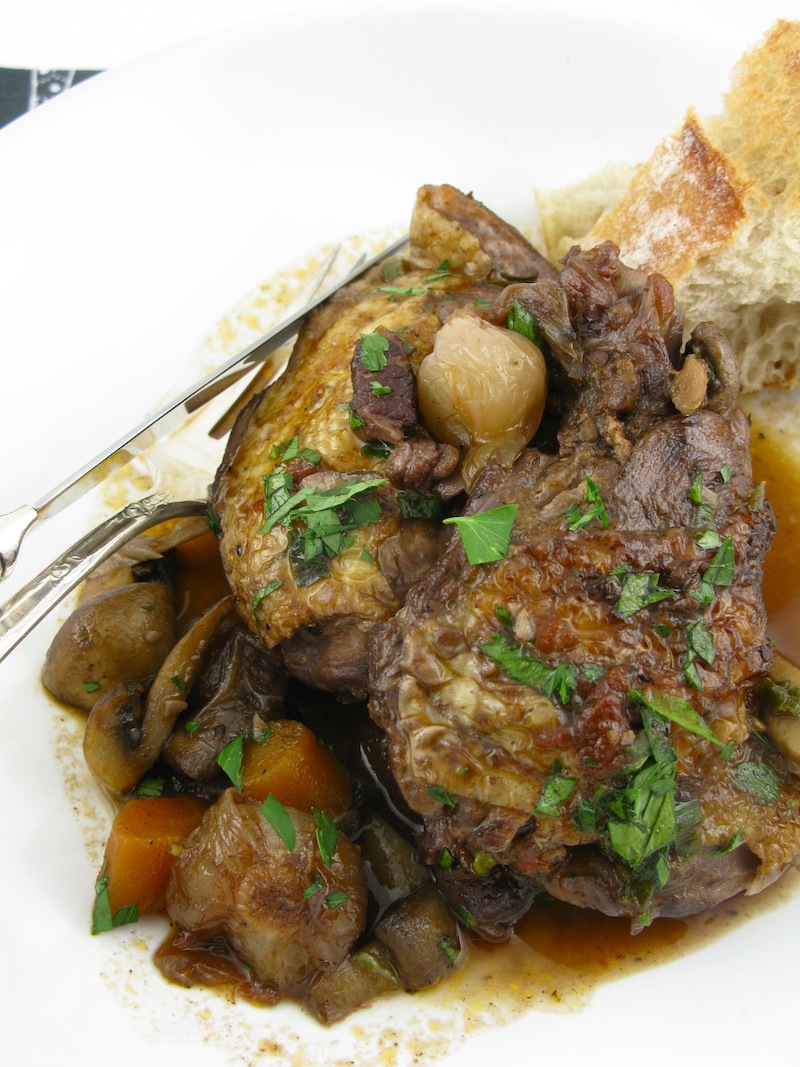
This year would have been Julia Child’s 100th birthday, and in honor of this remarkable woman who truly brought classic French cooking into the American home, a select group of food bloggers has been asked to join together with restaurants, chefs and bookstores for a national campaign celebrating Julia and her legacy. A panel of culinary luminaries, including Chef Thomas Keller and food writer Amanda Hesser, has selected their most beloved 100 Julia Child recipes which we, in the weeks running up to her birthday, will be cooking, baking and blogging. Today, I have recreated two recipes (this week’s and last’s): Julia’s incredible Coq au Vin and a Mousse au Chocolat, with which I have created, using homemade ladyfingers and served with a Berry Cointreau Coulis, a Charlotte au Chocolat. 

And as Julia Child herself would have said: Bon Appétit!

Join this tribute to the Grande Dame of French cooking by following @JC100 and the hashtag #JC100 on Twitter and liking the Julia Child Facebook page.

For Julia, a simple lunch of sole meunière -- her first meal in Paris -- was life changing and inspired her 40-year love affair with food and the start of a cooking revolution in America. How has she changed your life or your way of cooking, and what is your favorite recipe from Mastering the Art of French Cooking? 

DISCLOSURE: My dear friend Alessio of Recipe Taster was visiting yesterday and I wrangled him into cooking and preparing these two dishes with me. And he survived. Thank you, Alessio, for your courage, your cooking advice and brilliant kitchen talents! We did make slight alterations to the recipes to account for taste.
 
COQ AU VIN
From Mastering the Art of French Cooking, by Julia Child, Simone Beck, Louisette Bertholle


4 oz (120 g) smoky lardons or slab bacon, about 1/2-inch (1 cm) thick, cut into ½-inch (1 cm) slices
2 ½ to 3 lbs (about 1.5 kg) chicken pieces, or enough for 4 people
2 Tbs olive or good cooking oil
Salt and freshly ground black pepper
¼ - 1/3 cup (65 to 85 ml) brandy, optional but recommended
2 carrots, cleaned, trimmed and sliced into ½-inch- (1 cm) thick coins
2 cloves garlic, puréed or finely minced
1 bay leaf
¼ tsp thyme, fresh or fresh dried
1/3 cup (65 ml) canned Italian plum or cherry tomatoes
2 ½ - 3 cups young fruity red wine*
1 – 2 cups (250 – 500 ml) chicken stock
Chopped fresh flatleaf parsley

10 oz – 1 lb (300 – 500 g) fresh white mushrooms or Champignons
Butter or olive oil for sautéing, more or less as desired
2 Tbs butter
1 Tbs chopped chives or the greens from the pearl onions

16 – 20 small pearl onions – about 1 cup or so – no more than 1-inch (2 cm) width, or more as desired
Butter or olive oil
½ cup red wine
Small amount chicken stock or water and a pinch of cube to braise
1 – 2 bay leaves
Pinch fresh dried thyme

* Julia recommends a Zinfandel, Mâcon or Chianti-type wine; we used a Gamay which was recommended by my wine seller and was excellent!

Clean and trim the chicken pieces, removing excess skin and fat pockets; rinse and pat dry.

In a large heavy pot or Dutch oven, heat a tablespoon of olive oil and then add the lardons; fry, tossing often, until crispy. Remove the lardons with a slotted spoon to a plate, leaving the fat/bacon grease in the pot. Add an additional tablespoon of olive oil to the fat in the pot if necessary and add the chicken pieces in one layer; do not crowd. Brown the chicken on all sides. If need be, brown the chicken in batches. Once all of the chicken is well browned, return all of the pieces to the pot and add the brandy; allow the brandy to boil until almost evaporated, only about a minute or two.

Return the cooked lardons to the pot with the chicken; add the carrots, garlic, bay leaf, thyme, the tomatoes, the wine (we added closer to 2 ½ cups wine; if we had added all 3 cups wine the chicken would have been immersed in the wine and would have left no room for chicken stock) and season lightly with salt and pepper. Add enough of the chicken stock to just barely cover the ingredients.

Bring just to the boil, reduce heat to a simmer, cover partially and allow to simmer until the chicken is cooked through and very tender, about 45 minutes to an hour.

Meanwhile, prepare the braised onions and sautéed mushrooms:

Clean and trim the white pearl onions. Sauté in 1 tablespoon of browned butter, 1 tablespoon olive oil and a pinch of sugar until golden. Add ½ cup red wine (the same wine used for the Coq au Vin) and cook for several minutes until the wine evaporates and leaves a glaze in the bottom of the pan. Add enough chicken stock to braise the onions – not more than half a cup, just enough to come up about ¼ inch, with the bay and thyme; allow onions to simmer until tender. Season to taste, if needed. Remove from heat and set aside.

Clean, trim and quarter the mushrooms and sauté in a tablespoon or 2 of butter. Until tender and browned. Season with salt and pepper and toss in the chopped chives. Remove from heat and set aside.

If the sauce is too watery once the chicken is tender and cooked, simply lift the chicken and vegetables out of the pot and continue to simmer until the sauce reduces to desired consistency. Skim off the fat from the surface of the sauce, taste and correct seasoning. Return the chicken and vegetables to the sauce in the pot, add the braised onions and sautéed mushrooms and reheat gently, simmering for a few minutes so the flavors meld.


This is a fabulous dish to make ahead of time and reheat; the chicken becomes even more tender and the flavors become unified and richer. Serve simply over rice or with a vegetable. Garnish with chopped fresh parsley and enjoy with a glass or two of red wine.

CHARLOTTE AU CHOCOLAT 


Alessio and I prepared Julia’s recipe for Mousseline au Chocolat (translated roughly as Chocolate Mousse). We softened about ½ teaspoon powdered gelatine in the cold coffee for 5 - 10 minutes before adding the coffee to the chopped or broken chocolate and melting the two over a bain marie, allowing the gelatine to dissolve in the melted liquid chocolate/coffee. We added extra Cointreau along with the coffee to the chocolate. As we desired to make a Charlotte, the gelatine guaranteed a firmer texture that would hold its shaped when unmolded. The cubed butter to be whisked into the melted chocolate should not be too warm; if, once whisked in, the chocolate/butter mixture seems too watery or liquid, simply place the bowl in a larger bowl over cold water and whisk until it thickens and becomes creamier.

Once the Mousseline is prepared, allow to cool to a thick consistency before filling the lined Charlotte mold.

I prepared my own recipe for Ladyfingers: please find the recipe here. I piped out fingers the height of my Charlotte mold as well as piping out a small circle for the top and a larger circle for the bottom. The sugary, crispy sides of the fingers and the two rounds will be on the outside, the inverse, softer sides of each will be brushed with syrup.

We prepared a simple syrup with water and sugar – about ½ cup water to 1/3 cup granulated sugar – to which added a piece of lemon zest and a squeeze of lemon juice, about ½ tablespoon or to taste, and 1 tablespoon Cointreau. We used this syrup to brush the inside surface of the ladyfingers.

Once the Charlotte mold is lined with ladyfingers all around and the smaller round is place in the bottom (which, once flipped, will be the top) and the fingers and top are brushed with syrup, simply pour in the Mousseline au Chocolat, place the larger round on top of the chocolate cream, cover the whole with plastic wrap and place in the refrigerator to set overnight.

Prepare the Berry Coulis with 2 pints fresh strawberries and 1pint fresh raspberries, reserving a few prettier ones of each for decoration. Clean the raspberries and clean, trim and slice the strawberries and put them all together in a bowl. Add a few tablespoons or more of the Cointreau sugar syrup to the bowl and toss. Allow to macerate. Before serving, purée ½ to 2/3 of the berries with some of the rendered juices and add back to the remaining berries in the bowl. Taste and add either more of the sugar syrup, Cointreau, lemon juice or granulated sugar to taste, depending on how sweet, boozy or tart you like your Coulis.

When ready to serve: Remove the Charlotte from the refrigerator, trim the excess ladyfingers that stick above the top round of cake and invert carefully onto a serving platter. Dust the top with a bit of powdered sugar and cocoa powder, decorate with the reserved whole berries and serve with the Berry Coulis.

Labels

أحدث المواضيع

 
Support : Creating Website | Johny Template | Mas Template
Copyright © 2013. Entries General - All Rights Reserved
Template Created by Creating Website Published by Mas Template
Proudly powered by Blogger