Recent Movies
‏إظهار الرسائل ذات التسميات Intellectual Developmental Disorder. إظهار كافة الرسائل

DSM-5 Autism: Globe & Mail Ignores Invisible Intellectually Disabled Autistics, Dr. Yeargin-Allsopp's Vast Majority


Canada's Globe & Mail is late to the discussion, once again, of major autism issues. This time, Parents of autistic kids fear diagnostic changes will mean reduced services, the Globe is parroting the concerns of the major US corporate media over the possible impact of the DSM-5's New Autism Spectrum Disorder on persons with Asperger's and High Functioning Autism.  Like the US corporate media the Globe simply ignores the probable impact, on intellectually disabled autistic persons of the express exclusionary language of Mandatory Criterion A of the New Autism Spectrum Disorder.

Mandatory Criterion A of the New Autism Spectrum Disorder states:


Autism Spectrum Disorder
Must meet criteria A, B, C, and D:
A.    Persistent deficits in social communication and social interaction across contexts, not accounted for by general developmental delays, and manifest by all 3 of the following:
1.     Deficits in social-emotional reciprocity; ranging from abnormal social approach and failure of normal back and forth conversation through reduced sharing of interests, emotions, and affect and response to total lack of initiation of social interaction,
2.     Deficits in nonverbal communicative behaviors used for social interaction; ranging from poorly integrated- verbal and nonverbal communication, through abnormalities in eye contact and body-language, or deficits in understanding and use of nonverbal communication, to total lack of facial expression or gestures.
3.     Deficits in developing and maintaining relationships, appropriate to developmental level (beyond those with caregivers); ranging from difficulties adjusting behavior to suit different social contexts through difficulties in sharing imaginative play and  in making friends  to an apparent absence of interest in people.

The highlighted expression will exclude some from an autistm diagnosis where Criterion A can be accounted for by general development delay.  General developmental delay is not a separate category in the DSM-5 at least not under that title. It is found under the diagnosis  Intellectual Developmental Disorder (IDD):

A 00 Intellectual Developmental Disorder

Updated July 5, 2011

Intellectual Developmental Disorder is a disorder that includes both a current intellectual deficit and a deficit in adaptive functioning with onset during the developmental period. All three of the following criteria must be met.
A.         Intellectual Developmental Disorder is characterized by deficits in general mental abilities such as reasoning, problem-solving, planning, abstract thinking, judgment, academic learning and learning from experience.Intellectual Developmental Disorder requires a current intellectual deficit of approximately 2 or more standard deviations in Intelligence Quotient (IQ) below the population mean for a person’s age and cultural group, which is typically an IQ score of approximately 70 or below, measured on an individualized, standardized, culturally appropriate, psychometrically sound test. 
            AND
B.         The deficits in general mental abilities impair functioning in comparison to a person’s age and cultural group by limiting and restricting participation and performance in one or more aspects of daily life activities, such as communication, social participation, functioning at school or at work, or personal independence at home or in community settings. The limitations result in the need for ongoing support at school, work, or independent life. Thus, Intellectual Developmental Disorder also requires a significant impairment in adaptive functioning. Typically, adaptive behavior is measured using individualized, standardized, culturally appropriate, psychometrically sound tests. 
            AND
C.         Onset during the developmental period.  (Underlined dark bold highlighting added - HLD) 

Impairment in communication and social participation will support a diagnosis of
Intellectual Developmental Disorder. A person with Intellectual Developmental
Disorder and deficits in social participation and communication will by definition have those deficits accounted for by his/her IDD and will be excluded from an autism diagnosis by operation of the exclusionary wording in Mandatory Criterion A of the DSM-5 Autism Spectrum Disorder. 

None of the spokespersons for the DSM-5 Neurodevelopmental Workgroup Committee have explained how these two provisions can exist in the DSM-5 without excluding  intellectually disabled persons from an Autism Spectrum Disorder diagnosis.  To the contrary Dr. Catherine Lord has already confessed a clear intent on the committee's part to exclude from an autism diagnosis those with intellectual disabilities. 

The Globe & Mail, in fairness, is not a frequent reporting source on autism disorders.  It is probably just following the corporate media trend in the US ... ignoring those described by CDC autism expert Dr. Marshalyn Yeargin-Allsopp as the vast majority of those diagnosed with DSM-IV Autistic Disorder (AD) ... those with AD and intellectual disabilities.

Not Accounted For By General Developmental Delays: In DSM-5 Era Life for Autism's Invisible Vast Majority Is About To Get Much Harder


DSM-5 Autism Spectrum Disorder Will Exclude 
Autism's Vast Majority  Of Intellectually Disabled

While the New York Times, the CBC and other mainstream media giants debate the DSM5's potential exclusion of high functioning autistic persons from autism diagnosis barely a whisper is heard about the express exclusion of autism's vast majority of intellectually disabled. The exclusion of the intellectually disabled from the DSM5's New Autism Spectrum Disorder is not a potential effect, it is the express and intended effect of the language of mandatory criterion "A" as recently confessed by Dr. Catherine Lord.

"Autism Spectrum Disorder


Must meet criteria A, B, C, and D:


A. Persistent deficits in social communication and social interaction across contexts, not accounted for by general developmental delays, and manifest by all 3 of the following:"


Dr. Lord made it clear in her interview with the NYT that the APA's primary means of addressing the autism epidemic wasn't by removing high functioning autism from the DSM5 for that matter by conducting research into the environmental causes of autism. The APA will challenge the autism epidemic by redefining autism's vast majority of intellectually disabled out of the New Autism Spectrum Disorder:

"Catherine Lord, the director of the Institute for Brain Development at NewYork-Presbyterian Hospital, and a member of the committee overseeing the [DSM-5 autism] revisions, said that the goal was to ensure that autism was not used as a “fallback diagnosis” for children whose primary trait might be, for instance, an intellectual disability or aggression." [Bracketed terms added for context - HLD]


Exclusion Criteria - Not Accounted For By General Developmental Delays


Dr. Lord's confession is confirmed by the words "not accounted for by general developmental delays.  The "not accounted for by" is recognized as an exclusion criteria formula used in the current DSM-IV.  It is not controversial or contentious  (particularly given Dr. Lord's confession) to read those words, as used in the DSM-5, as excluding autism diagnoses in cases involving intellectual disability or as it is also known in the DSM-5: A00,  Intellectual Developmental Disorder. 


The mainstream media, led by the NYT, is obsessed with the very high functioning persons at the barely autistic end of the current autism spectrum.  Autism researchers also focus on this point.  Very few display any interest in those most severely affected by autism.  Instead of addressing the many serious and harmful effects confronting those on the autism spectrum who are intellectually disabled the APA simply redefines autism ... and defines away the most serious problems currently associated with autism as illustrated in this article on wsiltv.com: 

"Working with young autistic children is key to helping them become more functional in society.

"They have difficulties interacting with people with their social communication," explains Kirsten Schaper, the Autism Center Clinic Director in Carbondale.

The Autism Center at Southern Illinois University works with about 16 autistic kids a semester, far less than the number of people that come seeking treatment.

"I'd say 90 percent of the referrals to the center do not have autism," says Schaper.

Schaper says mis-diagnosis of autism is rampant in the U.S., partly because the criteria to diagnose the disorder are vague and subjective.

"We do have a lot of referrals for kids for challenging behaviors, tantruming, head-banging, aggression, self-injury, but these are not characteristics of autism spectrum disorder," Schaper explains.

Now a group of autism experts are tightening the criteria for identifying the disorder by stating specific characteristics to look for. Some parents fear their child, who has mild symptoms that were diagnosed as autism, will no longer get treatment under the new rules. But Schaper says the new criteria should, actually, better help those kids.

"Kids who have maybe an intellectual disability, or a language disorder, or maybe a behavior disorder, rather than autism, these kids will not be identified as having autism, and hopefully get the correct diagnosis, and therefore the correct treatment for whatever disorder they're having." [Bold Emphasis Added - HLD]

Hopefully get the correct correct diagnosis, and therefore the correct treatment for whatever disorder they're having?  NONSENSE. The APA is changing the rules  so psychiatrists, psychologists and other health care professionals can ignore the most serious cases of autism and dump autism's vast majority in the invisible category ... now to be known as Intellectual Developmental Disorder. In the US where more and more states are requiring insurers to provide coverage for autism the financial hit they experience will now be minimal ... a permanent gift from the American Psychiatric Association.

Frankly, as a father of a 16 year old son with autistic disorder and profound developmental delays, my trust in the psychiatry profession is declining rapidly with each passing day.  Life will be easier for the members of this profession who will now address the autism challenge by ignoring the most difficult cases.  For autism's vast majority of intellectually disabled though, they will now be even more invisible, more forgotten, more ignored as they are dumped in the Intellectual Disabled Development bin.  Life for autism's vast majority is about to get much, much harder in the era of the DSM-5's New Autism Spectrum Disorder.

DSM-5 Autism Spectrum Disorder: 3 Domains Become 2 and Exclude Intellectually Disabled


In the DSM-5 the new Autism Spectrum Disorder will, for the most part focus on those with Aspergers' and high functioing autism. The vast majority of those with Autistic Disorder who are also intellectually disabled will be excluded. This is clear from the wording used in the proposed new Autism Spectrum Disorder and in the wording of the new Intellectual Developmental Disorder.  That interpretation is also confirmed by the official rationale for the new ASD.

The new Autism Spectrum Disorder, as I have previously written, is misnamed. It would be much more accurately described as New Asperger's Spectrum Disorder.  The new version, which will be rubber stamped, on final review by the APA DSM-5 work groups, will exclude persons with intellectual disability as the current DSM-IV Asperger's criteria does and will remove language delay and general communication impairment also making the ASD consistent with DSM-IV Asperger's criteria.  In addition the DSM-5 ASD criteria make it clear that although the New ASD must be  present from infancy or early childhood it may not be detected until later because of minimal social demands and support from parents or caregivers in early years. This consideration helps those on the milder end of the current autism spectrum.  

As an example my son who is severely affected by his Autistic Disorder and profound developmental delays was diagnosed at age 2 several months after we had begun to seek medical attention for his lack of development.  We knew nothing about autism but his lack of development was apparent and disconcerting. By contrast the media is full of stories of very high functioning persons, some of whom are now quite famous self appointed spokespersons on behalf of all persons with autism who were diagnosed as teens or adults. The  "may not be detected until later" qualifier helps ensure that the New ASD captures those with Asperger's and High Functioning Autism.

I have previously noted that the criteria for the New ASD also excludes those with intellectual disabilities. It does so  by:

1. Establishing 4 mandatory criteria each of which MUST be met before ASD will be diagnosed:


2. Excluding fulfillment of mandatory criterion A where that criterion can be accounted for by general developmental delay:


If a child has general deficits in communication it seems obvious that the general communication deficit will include social communication deficit.  The DSM-5's new Intellectual Developmental Disorder confirms this assertion in mandatory Criterion B which specifically states that deficits in general mental ability impair functioning in various areas including communication and social participation:


The  DSM-5's New Autism Spectrum Disorder rationale also confirms the exclusionary effect of the new Autism Spectrum Disorded Mandatory Criterion A by explaining why 3 domains will be collapsed into 2:


The explanation does continue on but the first example highlights why the reduction from 3 domains to 2 confirms that DSM-5 ASD mandatory Criterion A will exclude the intellectually disabled. As the DSM-5 description of Intellectual Developmental Disorder states the deficits in general mental abilities will impair functioning by limiting and restricting participation and performance in daily life activities such as communication and social participation.  The rationale offered for the new ASD meanwhile states the obvious:  deficits in communication and social behaviors are inseparable. 

When a person suffers from general mental deficits sufficient to meet an Intellectual Developmental Disorder diagnosis he/she will suffer impairment in communication and social interaction.  They are inseparable.  In any instance where a persons meets the IDD criteria they will not meet criterion A of the New ASD because their  persistent deficits in social communication and social interaction will be accounted for by general developmental delay.  

The description  of the DSM-5's new Autism Spectrum Disorder's mandatory Criterion A and the description of the new Intellectual Developmental Disorder combine to exclude from an Autism Spectrum Disorder diagnosis those who are intellectually disabled.  That interpretation is confirmed both by common sense and by the DSM-5 rationale for the new ASD.  3 domains become 2.  Deficits in communication and social behaviors are inseparable.  Those with IDD will suffer deficits in communication and social behavior and will be accounted for by their IDD diagnosis thus excluding them from an ASD diagnosis. 

In the brave new world of the DSM-5, as in the mainstream media, as in Hollywood, as in autism research generally, the Intellectually Disabled will be excluded from the autism spectrum. 

Autism and Intellectual Disability in the DSM5: My Submission to the DSM5 Neurodevelopmental Disorders Work Group


July 17 2011

Neurodevelopmental Disorders DSM Work Group
American Psychiatric Association

Dear NDD Work Group Members

I am the father of a 15 year old son diagnosed at age 2 with Autistic Disorder and assessed with profound developmental delays conditions which severely restrict his everyday functioning. He requires, and will require, 24/7 adult supervision. Since his diagnosis 13 years ago I have actively advocated here in New Brunswick, Canada for government funding of evidence based early intervention and autism specific training of education assistants and resource teachers who work with autistic students. With other parents we have enjoyed some success in  these areas although we have had much less success in advocating for adequate adult care and treatment facilities for autistic adults. Throughout our efforts we were guided, and to the extent that we succeeded, we did so because of the leadership of American autism researchers such as Dr. O. Ivar Lovaas and others who established the evidence basis for the effectiveness of applied behavior analysis as an autism therapy. Throughout this time from 1998 the DSM definition of Autistic Disorder and the other Pervasive Developmental Disorders, the latter of which has become identified in popular usage and in research as the Autism Spectrum,  was constant. Now the entire category for the "Autism Spectrum" is formally being merged together in the DSM-5  into one disorder divided only by the extent to which daily functioning levels are impaired by the newly defined ASD. I have two primary concerns about this new Autism Spectrum Disorder as it goes through substantive change at both the "high functioning" and "low functioning" end of the "autism spectrum".

1) The effect of the changed definition on research conducted under the  DSM-IV definition of Autistic Disorder and the other PDD's. 

Although it is a far from being a unanimously held position,it has been often mentioned in discussion of the startling increases in rates of autism diagnoses that the increases are accounted for entirely by the definition changes of autism in the DSM-IV, even though that occurred some 17 years ago, and increased social awareness. It seems entirely predictable that a newly changed definition will also confound our understanding of real autism prevalence. 

2) The exclusion from Autism Spectrum Disorder diagnosis of those with Intellectual Disabilities.

As the father of a son who is severely affected by Autistic Disorder and who is "profoundly developmentally delayed" I am most concerned with the language of the DSM5's new  A 09 Autism Spectrum Disorder which appears to exclude those, or many of those, with intellectual disabilities from an Autism Spectrum Disorder diagnosis. The proposed Autism Spectrum Disorder definition stipulates that criteria A,B,C and D must all be met in order for an ASD diagnosis to be given. Criterion A states:

A.    Persistent deficits in social communication and social interaction across contexts, not accounted for by general developmental delays,...

The wording I have highlighted, "not accounted for by general developmental delays" when used in the context of persistent deficits in social communication and social interaction across contexts appears to exclude any one with an Intellectual Disability from also being diagnosed with Autism Spectrum Disorder, since Intellectual Disability will involve exactly those deficits.  

This interpretation of the effect of Criterion A of the proposed Autism Spectrum Disorder is also supported by reference to Criterion B of the proposed A 00  Intellectual Developmental Disorder:

B.         The deficits in general mental abilities impair functioning in comparison to a person’s age and cultural group by limiting and restricting participation and performance in one or more aspects of daily life activities, such as communication, social participation, functioning at school or at work, or personal independence at home or in community settings.

It seems clear that in any case of Intellectual Developmental Disorder the mandatory ASD Criterion A, persistent deficits in social communication and social interaction, will always be "accounted for by general developmental delays" and an Autism Spectrum Disorder diagnosis will be precluded.

I am aware that  Ms Lisa Jo Rudy of About.com autism has communicated recently with Dr. Bryan King of the NDD work group on the issue of the possible  exclusion of intellectually disabled from autism diagnoses. Dr. King provided the following response:

"There is no explicit desire to move anyone in to or out of specific diagnostic groups, however, by creating more specificity we believe that people may be given diagnoses that better capture their individual conditions. The qualifier above about general developmental delays ensures that the social communication deficits are more specific, and also potentially allows for earlier diagnosis if appropriate.

Just as typically developing infants and toddlers are able to engage in very rich social communication and interaction across contexts, appropriate to their developmental level, so too most individuals with intellectual delays or disabilities are also able to communicate. On the other hand, significant deficits in social communication in toddlers may suggest the presence of autism. What the criterion above is meant to ensure is that clinicians take into account what is typical in terms of social communication abilities at a given age or developmental level, and not assume, for example, that a lack of social perception in a teenager with intellectual disability not automatically suggest the presence of autism. As is currently the case, some individuals with Down Syndrome may also meet criteria for autism; but most will not."

The language of the proposed DSM is express and intentional. The absence of desire to remove anyone in or out of the groups does not mean that there is no intent to do so whether desired or not. It is the wording of the proposed revision that will determine future diagnoses. The exclusionary wording I have referenced is not explained in any meaningful way by Dr. King's comment. "More specific" to my humble interpretation is simply another way of saying not part of a general intellectual deficit. Which again indicates that the Intellectually Disabled will be excluded from the DSM's New Autism Spectrum Disorder.

I have commented on several occasions on my blog site Facing Autism in New Brunswick about the high numbers of persons with autism disorders who are also intellectually disabled. I  have cited sources for the pre-1994 definition of autism including CDC autism expert Dr. Marshalyn Yeargin-Allsopp who stated that those with intellectual disabilities constituted "the vast majority" of those with autism prior to the 1994 changes which added Asperger's Disorder to the PDD's.  The Canadian Psychological Association also referenced 80% of persons with non-Asperger's autism as having intellectual disabilities a figure which seems consistent with the CDC's two surveys showing 41-44% of persons with any autism spectrum disorder, including Aspergers, as having intellectual disabilities.  The 1994 changes diluted the 80% figure to roughly 40% by simply adding a group who by definition did not have intellectual disability, those with Asperger's. Now the DSM5 is poised to push the intellectually disabled off the spectrum completely and will essentially  redefine autism as what is currently Asperger's disorder.  

The DSM5  attempt to completely separate Autism and Intellectual Disability ignores the historically close relationship between those with ID  and those severely affected by autism disorder however labelled and ignores the possibility that the the ASD deficits are just components, differing in severity and expression, of intellectual disability. An Italian study has looked at the relationship between Intellectual Disability and called for more research of that relationship:

Psychiatry Unit, Department of Neurological and Psychiatric Sciences, University of Florence, Hospital of Careggi, Florence, Italy. gplamalfa@videosoft.it

Abstract

BACKGROUND: In 1994, the American Association on Mental Retardation with the DSM-IV has come to a final definition of pervasive developmental disorders (PDD), in agreement with the ICD-10. Prevalence of PDD in the general population is 0.1-0.15% according to the DSM-IV. PDD are more frequent in people with severe intellectual disability (ID). There is a strict relationship between ID and autism: 40% of people with ID also present a PDD, on the other hand, nearly 70% of people with PDD also have ID. We believe that in Italy PDD are underestimated because there is no agreement about the classification system and diagnostic instruments.
METHOD: Our aim is to assess the prevalence of PDD in the Italian population with ID. The Scale of Pervasive Developmental Disorder in Mentally Retarded Persons (PDD-MRS) seems to be a very good instrument for classifying and diagnosing PDD.

RESULTS: The application of the PDD-MRS and a clinical review of every individual case on a sample of 166 Italian people with ID raised the prevalence of PDD in this population from 7.8% to 39.2%.

CONCLUSIONS: The study confirms the relationship between ID and autism and suggests a new approach in the study of ID in order to elaborate a new integrated model for people with ID."

Conclusion:


With great respect to Dr. King and the DSM5 NDD work group I submit that the proposed Autism Spectrum Disorder wording of the DSM5 along with the Intellectual Developmental Disorder clearly operate to remove those with Intellectual Disability from the autism spectrum.  I have no way of assessing the motivation for this change with any certainty. I do not really see the explanation offered by Dr. King as providing a coherent rationale for such a fundamental change. Some critics of the previous DSM-IV changes including Dr. Allen Frances have expressed regrets about the unintended consequences that flowed from that last revision. I can really see no good coming to persons with autism and intellectual disability who will no longer be considered autistic because mandatory criterion A can be accounted for by general developmental delay.  With no intent to insult or engage in confrontation it looks more like the intent is to make life easier for doctors in making autism diagnoses without having to explore the more complicated aspects of a diagnosis when intellectual disability is present.  It also makes it easier to calm the fears of those with Asperger's diagnoses who worried about being lumped together with those with autism in the new autism spectrum disorder. What is not at all clear is how this really helps in any way  those with autism and intellectual disability.

I ask this working group to reconsider its decision to add language excluding intellectually disabled from the proposed Autism Spectrum Disorder in the DSM5.

Respectfully,

Harold L Doherty
Fredericton, New Brunswick, Canada

Confirmation DSM-5's New Autism Spectrum Disorder Will Exclude Intellectually Disabled


I have written previously that persons who presently have autistic disorder or PDD-NOS and who are also intellectually disabled will be removed from the DSM-5's New Autism Spectrum Disorder. Whereas those with intellectual disability once constituted autism's vast majority as described by CDC autism expert Dr. Marshalyn Yeargin-Allsopp the 1994 addition of Asperger's Disorder reduced their numerical weight on the autism spectrum.  With the new DSM-5 wording has intentionally been added to the definition of autism to exclude persons with intellectual disability from autism diagnoses. To be diagnosed with autism a person must meet all 4 criteria, A, B, C and D.  Criteria A requires the presence of "persistent deficits in social communication and social interaction across contexts, not accounted for by general developmental delays."  Now, an email exchange between Lisa Jo Rudy of About.com autism spectrum disorders and Dr. Bryan King of the APA's DSM-5's Neurodevelopmental Work Group confirms that the effect of the DSM's New ASD will be to exclude at least some persons with intellectual disability from an autism spectrum disorder diagnosis:


"My Question for Dr. King

There seems to be a desire to remove people with "Persistent deficits in social communication and social interaction across contexts, not accounted for by general developmental delays" from the ASD category. Does this mean that a child with Mental Retardation (also called Intellectual Delays) no longer qualify for an Autism Spectrum diagnosis? Would that person wind up dually diagnosed with Intellectual Development Disorder and social communication disorder rather than with an ASD diagnosis?


His Response

There is no explicit desire , however, by creating more specificity we believe that people may be given diagnoses that better capture their individual conditions. The qualifier above about general developmental delays ensures that the social communication deficits are more specific, and also potentially allows for earlier diagnosis if appropriate.

Just as typically developing infants and toddlers are able to engage in very rich social communication and interaction across contexts, appropriate to their developmental level, so too most individuals with intellectual delays or disabilities are also able to communicate. On the other hand, significant deficits in social communication in toddlers may suggest the presence of autism. What the criterion above is meant to ensure is that clinicians take into account what is typical in terms of social communication abilities at a given age or developmental level, and not assume, for example, that a lack of social perception in a teenager with intellectual disability not automatically suggest the presence of autism. As is currently the case, some individuals with Down Syndrome may also meet criteria for autism; but most will not."


There may or may not be an "explicit desire  to move anyone in to or out of specific diagnostic groups" but the wording is being added intentionally to achieve a specific result and it is clear that the intended result is that social communication deficits be more specific that is .... not part of social communication deficits arising in cases of general developmental delay.

The DSM-5's New Autism Spectrum Disorder will add more persons on the high functioning Asperger's end of the spectrum and will reduce the numbers at the lower intellectually disabled end of the spectrum. The vast majority of the original autism described by Dr. Marshalyn Yeargin-Allsoop has been given the boot, kicked off the autism spectrum entirely, or nearly entirely.

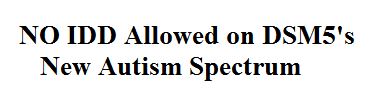
There will be no Intellectually Disabled allowed on the DSM-5's New Autism Spectrum.

Asperger's is the New Autism: No Intellectually Disabled Allowed in the DSM-5's New Autism Spectrum Disorder

"the autism umbrella has since widened to include milder forms, says Dr. Marshalyn Yeargin-Allsopp, a medical epidemiologist at the Centers for Disease Control and Prevention. For example, it now includes Asperger syndrome, where the sufferer is socially impaired, but experiences typical language development. Another difference between past and present autism diagnosis involves the presence of intellectual disabilities, adds Yeargin-Allsopp. During the 1960s and 1970s, the vast majority of those diagnosed with autism had an intellectual disability but today, only about 40% have one."

Dr. Marshalyn Yeargin-Allsopp, Canadian Medical Association Journal,CMAJ • July 13, 2010; 182 (10). First published June 7, 2010; doi:10.1503/cmaj.109-3274  


Dr. Yeargin-Allsopp's description of the diminution of autism's vast majority, those with intellectual disability, is noteworthy today as we await the commencement of the DSM-5 era and the complete elimination from any autism diagnosis of persons with intellectual disabilities. That accomplishment will be achieved by the DSM-5's New Autism Spectrum Disorder definition and diagnostic criteria which expressly exclude an ASD diagnosis in instances of general developmental delay:


The New Autism Spectrum Disorder in the DSM-5 will eliminate any debates over the exent of intellectual disability amongst those with autism spectrum disorders.  The new definition will complete the process begun in the DSM-IV of diminishing the rates of ID amongst those with autism by changing the definition of autism to exclude those with intellectual disability.   The formula is simple and straight forward.  To be diagnosed with autism a person must meet all 4 criteria, A, B, C and D.  Criteria A requires the presence of "persistent deficits in social communication and social interaction across contexts, not accounted for by general developmental delays".   If a person suffers from "general developmental delay" that will account for persistent deficits in social communication and social interaction across contexts and the person will not meet the mandatory Criterion A and will not  receive an autism spectrum diagnosis under the new DSM-5.

General developmental delays is a reference to the DSM-5 diagnostic category of Intellectual Developmental Disorder (IDD) which is described as including a current intellectual deficit and a deficit in adaptive functioning.  IDD is further described in two of the mandatory criteria for meeting and IDD diagnosis  as including deficits in general mental abilities. IDD mandatory criterion B refers expressly to impaired functioning in areas of daily life including communication and social participation.  An IDD diagnosis then would account for deficits in social communicaiton and social interaction and preclude an Autism Spectrum Disorder diagnosis under the DSM-5


 The exclusion of an autism diagnosis for persons who are generally developmentally delayed is a substantive change from the DSM-IV  which did not exclude an Autistic Disorder diagnosis in persons who suffered from  general developmental delay, intellectual disability or mental retardation:


The exclusion of persons with Intellectual Developmental Disorders from the New Autism Spectrum Disorder does have a precedent in the DSM-IV.  It is found in the DSM-IV's Asperger's Disorder which states in Criterion E that "there is no clinically significant delay in cognitive development or in the development of age-appropriate self-help skills".  And there it is "no cognitive development delay" from the DSM-IV Asperger's Disorder criteria becomes not accounted for by general developmental delay in the DSM-5's Autism Spectrum Disorder.   Asperger's becomes the New Autism in DSM-5 World.

Autism Speaks has long been aware of the APA intention to remove persons with intellectual disability from consideration for autism spectrum disorder diagnoses. Autism Speaks rarely mentions intellectual disability as an autism concern.   It has already been busy presenting Asperger's to the public as Autism  with the promotion of the careers and influence of John Elder Robison and Alex Plank.

Autism Speaks also helped fund the Korean "autism" prevalence study of Roy Richard Grinker who has been busy recasting Asperger's as autism and who went looking for "autism" amongst Korean students who functioned well in Korea's highly structured school environments.  No intellectually disabled were included amongst Grinker's findings of  large numbers of previously unknown autistics.  Of course Professor Grinker, the APA and "Autism Without Intellectual Disability Speaks" will have to readjust their autism prevalence numbers once the DSM-5 officially takes effect.  They will have to revise their autism rates downward to reflect the removal of persons with DSM-IV Autistic Disorder and intellectual disability from the DSM-5's Autism Spectrum Disorder.  Asperger's is the New Autism. 

Labels

أحدث المواضيع

 
Support : Creating Website | Johny Template | Mas Template
Copyright © 2013. Entries General - All Rights Reserved
Template Created by Creating Website Published by Mas Template
Proudly powered by Blogger