Recent Movies

It's TEA Time!

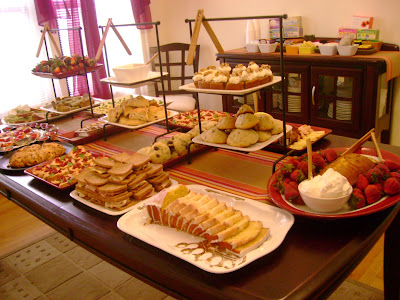
Tea has been around for centuries and over time, it has evolved into some unique flavors. To take a closer look & taste of teas, I hosted 2 tea parties today for my group, What's Cookin Chicago. For this event, I offered a tea bar filed with 16 different herbals (aka tisanes) and 4 varieties of tea. To complete my tea bar, I had some standard condiments, including white & raw sugar, honey, lemon slices and cream. At this event I provided a tea primer of how tea leaves are transformed from tree to cup. We got to try a variety of black, oolong, green, white and flavored teas, along with tisanes (herbals). Everyone attended brought in a teaparty dish to share that ranged from sweet to savory. It was all so delicious and was a wonderful spread to compliment my tea bar. Are you interested in learning about teas too? Well, here's some info I shared with my friends on tea...
  • Over 15,000 types of teas exist and they all come from the same plant species -- Camellia Sinensis -- which thrives in subtropical and tropical climates.
  • Tea gardens & estates can be found in India & China (the largest tea growers), Sri Lanka (aka Ceylon), Taiwan (aka Formosa), Japan, korea, Indonesia, Nepal, Australia, Argentina and Keyna.
  • Even though all teas come from the same single plant species, 3 things allow the teas to become different varieties: Provenance, Picking & Processing.
  • Provenance refers to where the tea leaves grow. Teas that are cultivated at high altitudes (3,000-7,000+ above sea level) are considered superior. Experts say this is because these specific teas take a longer time to mature, resulting in more flavor. These high altitude teas are also the most expensive because the yields are low and harvesting is difficult.
  • Picking refers to how and when the tea leaves are harvested. Traditionally, teas are harvested by hand by sometimes its also reaped by machine. Generally in countries like Japan, Taiwan and Brazil, teas are harvested by machine because labor costs make hand picking expensive. Most teas are made from picking the smallest & youngest leaves & buds, but it can also consist of just the tip (bud) plus the first 2 or 3 leaves. Teas consisting of just the buds or the buds + the 2 leaves are considered superior. Timing also plays a role - leaves picked during the first harvest of the season is also known as the first flush; the second harvest of the season is also known as the second flush, etc. The first flush is known to be the greenest and most astringent teas. Second flush is browner and very flavorful. Whereas the third flush is brown and mellower.
  • Processing is the most important part and involves drying out the tea leaves to prevent growth of fungi, to develop flavor and color and to provide a distinct appearance. There are four parts to processing tea leaves: Drying or Steaming, Shaping, Oxidation (Fermentation), and Firing.

  • Drying - After picking, black & oolong teas are dried out to reduce moisture and make the leaves softer & easier to work with. Green, yellow and white teasare steamed and preserved for color.
  • Shaping - Once the leaves are either dried/steamed, the tea leaves are rolled into shapes to breakup the leaf cells releasing sap.
  • Oxidation (Fermentation) - determines which category a tea falls into: green, white, yellow, oolong and black. This involves exposing the broken tea leaves and their sap to air. The air allows them to grow darker in color and to take on new aromas. White, yellow and green tea are not oxidizes abd are sometimes called unfermented. Oolong teas are oxidized for 1-2 hours and are called semi-fermented. Black teas are oxidized for 3-4 hours and are called fermented.
  • Firing - This step stops the oxidation process and allows moisture to evaporate and causes the sap to dry on the leaf. This preserves the tea for shipment and sometimes adds flavor.
  • As previously mentioned, there are 4 major varieties of teas: black, oolong, green and white as well as blended/spiced/flavored teas and herbals.
  • Black teas are what most of the teas in the world fall under and they have the strongest flavor.
  • Oolong teas are the most expensive and are from Taiwan (aka Formosa).
  • Green teas come from either China or Japan. Chinese green teas are pan fried and are golden green in color. Japanese green teas are steamed and are bright green with grassy, sea-like flavor.
  • White teas are young leaves or buds that have been shielded from sunlight to prevent the formation of chlorophyll and green color. They are not oxidized either and are often expensive because they are processed in small quantities.

  • Blended/spiced/flavored teas are mixed with pieces of dried fruit, spices or perfumed with essenses/oils for flavored, scented or spiced tea.
  • Herbals are also known as tisanes or infusions. These are not really teas at all. They do not contain any tea leaves - just flowers, fruit, herbs, roots, seeds or spices. They are great flavored and lack caffeine.

Here are pictures of my first tea party session:

Joelen's Sundried Tomato & Basil Bread

Maya's Date & Walnut Cake
Joelen's Classic Pound Cake
Megan's Chocolate Covered Strawberries
Dorothy's Cranberry Orange Scones
Carrie's Earl Gray Tea Shortbread Cookies
Cassandra's Cranberry Scones
Fong's Strawberry Tartlettes
Chigirls' Tea Sandwiches
Dhyana's Lemon Yogurt CakeChrissy's Blueberry Scones
Jen's Raspberry Danish
Teresa's Egg Salad
Chigirl's Cheese & Deli Plate
Kara's Tea Sandwich Platter

Here are pictures of my
second tea party session:
Susan's Preserves & Spreads Assortment

Yumi's Matcha Green Tea Shortbread

Evaline's Chocolate Brownies

Christina's Lemon Squares

Jen's Fruit Pasties

Joelen's Calmon Croquettes

John's Creme Brulee

Lisa's Cookie Bars

Art & Carolyn's Tea Sandwiches

Simona's Tea Sandwiches

Joelen's Savory Vegetable Rounds

Abbie's Carrot Cake

Donna's Chocolate Truffles

Catie's Biscotti

CHOCOLATE SPONGE CAKE

CONFESSIONS OF A GOURMANDE - Day 1

“Okay, your turn,” they said, as about a dozen pairs of eyes slid in my direction. “Tell us about yourself.” I have never been comfortable talking about myself, but here I was, the center of attention, albeit for just about a minute or two, having to introduce myself to the members of a Businessman’s (person’s) Club that my husband belongs to. Dinner with the Spouses Night.
“Well,” I hesitated, not quite knowing how to explain where I was at this point in my life. “I’ve done lots of things, had lots of careers. Now I stay at home, moral support for a hard-working husband. And I’ve started writing a book.”
“Ah, a book! About what?” Ummm...
“About food. About my relationship with food.”
“Is it a love-hate relationship?” someone asks, imagining, I am sure, a skinny woman battling body image.
“No, just love,” my husband rejoins. “Definitely love.”

Crazy woman, no good! as my husband would say. I am one of the food obsessed. You know the feeling - Friends stare at you goggle-eyed as you rhapsodize about your perfectly-cooked entrée or try and stir up a discussion about the merits of the chef as they are trying to share sailing stories. Or being brushed off as crazy by the fact that you leave for vacation with only restaurant guides packed into your suitcase. Sidelong, uncomfortable glances as you become engrossed in the restaurant menu until you start to sweat and then call over the waiter and demand he describe various dishes in detail before you are capable of being sure of your choice. Days are spent curled up with a pile of good cookbooks or your family begs you to leave the kitchen after a 3-day baking binge. At some point I started to feel like a misfit, like there actually may have been something wrong with me - and I started to resort to watching cooking shows in hiding, purchasing yet another cookbook and smuggling it into my bedroom stuffed under my coat as if to feed a dirty addiction or searching food blogs on-line like an adolescent visiting porn sites after his parents are in bed.

But a recent discovery has changed my life. This will all come out in time, but I have been liberated from those disapproving societal shackles and have decided to join the on-line community of food lovers, sharing stories, recipes, philosophies, explorations and memories.

CHOCOLATE SPONGE CAKE

My first recipe entry for my food blog! I am both excited and nervous. I haven’t quite understood how other people do this. Just dive in? I decided to make something that I have long wanted to do but I just hadn’t come across the right recipe. I have been making plain vanilla sponge cake for years - my recipe is handwritten (and smeared with decades-old cake batter) in a beat up old notebook that I started in college and have been dragging around the world for, oh, let’s just say for a very long time. I make it quite often for my husband who is watching both his waistline and his cholesterol (okay, the recipe has 6 eggs, but NO butter!), and though it calls for folding in beaten egg whites, it is quite simple to make. I decided to doodle around with it and I simply replaced 1/4 cup of the flour for the same amount cocoa powder and it came out beautifully! A bit more dense than the vanilla version and with a chocolate candy bar flavor. And it rose beautifully! It is perfect for breakfast or snacktime!

When I asked my husband how he liked it, he hesitated than said, “Well, it’s spongy. It’s a sponge cake.” Heavy on the innuendo....


1 1/4 cups flour
1/4 cup unsweetened cocoa powder
1 teaspoon baking powder
1/2 teaspoon salt
6 eggs, separated, preferably at room temperature
1 1/4 cups sugar
1/2 cup cold water
2 teaspoons vanilla extract
cream of tartar or salt and lemon juice (see recipe)

In a small bowl, blend the flour, cocoa powder, baking powder and salt.

Separate the eggs. Place the whites in a mixing bowl (plastic is better than glass for beating whites) with either 3/4 teaspoon cream of tartar or, as I do, a few grains of salt and 1 or 2 drops of lemon juice. Either will stabilize your whites. Set aside.

Put the yolks in a very large mixing bowl. Beat them with an electric beater on high speed for a few minutes until very thick and pale yellow. Add the sugar and continue beating for another couple of minutes.

Add the dry ingredients to the yolk/sugar mixture, alternating with the cold water and vanilla (dry-wet-dry-wet-dry), beating after each addition until blended, scraping down the sides as necessary.

Beat the whites until stiff peaks hold (you can reserve a couple of tablespoons of the sugar that you add to the yolks and add them gradually to the whites towards the end, after soft peaks start forming. This will really stiffen the whites).

Delicately fold the whites into the cake batter : begin by folding in about a third of the whites in order to lighten the heavy batter so as not to “break” the whites (knock out the air). Then fold in another third, then the final third. Don’t overdo it or, again, you will knock out too much air.

Pour into an ungreased 10-inch tube pan (preferably with removable bottom). Bake at 325°F (160°C) for 55 - 60 minutes until set. Cool inverted.

Medicare for Autism Now! Rally April 19th Oakville


"Medicare for Autism Now!" Rally


Saturday, April 19th, 2008

2:00 p.m. to 4:00 p.m.

Iroquois Ridge Community Center,

1051 Glenashton Drive,

Oakville, Ontario, L6H 6Z4

Why should you attend?

* Despite a decade of lobbying, collaborating and litigating – autism treatment is still excluded from our universal health care system. Canadian families from BC to Newfoundland and everywhere in between are still bankrupting themselves in order to provide treatment for their disabled children.

* The current and limited patchwork of funding and services provided through the provinces’ social services ministries could evaporate tomorrow with a change of government, or the stroke of a bureaucrat’s pen. No legislation or mandate exists within these social services ministries to deliver health care or to protect and enshrine our children’s medically necessary treatment.

* In 30 years of "advocacy", the only two initiatives which have achieved ANY success in obtaining treatment funding in any province has been litigation, and more recently, focused political action. Both were brought by volunteer parent groups.

* Autism is an epidemic of staggering proportions, it now afflicts one in every 150 children in North America, one in every 94 boys. Autism has become an election issue in the U.S. - Senators Clinton, Obama and McCain have all articulated extremely progressive positions. In 2006, the U.S. federal government unanimously passed the "Combating Autism Act" which allocated $945 million into research and treatment. The U.S. federal government recognizes their responsibility to intervene by acting to avoid a major health and social crisis.

* It is time for our federal government to recognize their responsibility to act! This is not a left or right issue – it’s a right or wrong issue!

* Today, all over Canada, parents of children with autism and growing numbers of fair-minded, but outraged Canadian voters expect our federal government to act. We are letting those who govern and those who wish to govern know they will be held accountable, regardless of party affiliation, at the ballot box in the next federal election.

Who should attend?

You – and every fair-minded Canadian you know!

In Canada, children with autism and their families suffer from political indifference. It will take the sustained energy and dedication of EVERY CANADIAN who desires a just society to correct this injustice. For our children’s sake, and the sake of future generations, we urge you to attend this rally. Please bring friends, family, kids, anyone and everyone you know who is appalled by the gross injustice done to our children every day by the governments of Canada and its provinces.

Come and find out how you can make your vote actually count!

Featured speakers will include:

Jean Lewis – Vancouver parent, B.C. Co-ordinator for "Medicare for Autism Now!" initiative

Harold Doherty – Fredericton parent, Maritime Co-ordinator for "Medicare for Autism Now!" initiative

David Marley – Vancouver supporter/advisor, B.C. Co-ordinator for "Medicare for Autism Now!" initiative

Stefan Marinoiu – Toronto parent, "Medicare for Autism Now!" supporter

Deborah Coyne – Toronto parent, "Medicare for Autism Now!" supporter

Please RSVP a.s.a.p. to: Jennifer O’Brien

Email: jobrien116@cogeco.ca


For more information regarding "Medicare for Autism Now!" – check out:

www.medicareforautismnow.blogspot.com

Non-Blogger Tasty Tool Entries!

I had a few non-blogger Tasty Tool blog event entries that were sent from friends. Here they are for you to enjoy. Stay tuned... The full Tasty Tools round up will be posted on April 7th!Goat Cheese Spread w Herbs and Olive Oil
(from whatscookingamerica.net)
-- submitted by Linda, Chicago


8 ounces goat cheese (about 1 cup)
2 tablespoons heavy whipping cream, more if needed
2 tablespoons extra-vergin olive oil, plus more for drizzling
2 tablespoons dry white wine
kosher salt and freshly ground black pepper
2 tablespoons chopped fresh herbs (choose at least two from the following: parsley, chives, tarragon, dill)
1 tablespoon finely grated lemon zest
good crackers or slices of walnut bread
1 pint cherry tomatoes
1 celery heart, cut into sticks

Put goat cheese, whipping cream, 2 tablespoons olive oil, and wine in a food processor (or mix in a bowl with a wooden spoon). Pulse just to blend. Mixture should be spreadable; if it's too thick, add 1 or 2 tablespoons more cream and pulse again. Season with salt and pepper, pulse again, and taste, adjusting seasoning as necessary.

Reserve 1 teaspoon herbs for sprinkling, and add rest to processor. Add 2 teaspoons lemon zest. Pulse once more to blend. Line a small (about 1 1/2-cup) round bowl or cup with a sheet of plastic wrap and fill with cheese mixture. Cover and chill at least 30 minutes and up to 24 hours.

To serve, invert bowl onto a serving platter and peel off plastic. With back of a spoon, level off top of cheese and make a small depression. Drizzle olive oil over top. Sprinkle with reserved herbs and lemon zest. Arrange crackers or bread slices, tomatoes and celery around cheese and let guests serve themselves.

Makes about 1 1/4 cups or 6 servings.

Eggs Florentine over Polenta Cakes
-- submitted by Cheryl, Chicago
1 serving


For polenta:
1 1/2 cups chicken stock
1/2 cup water
s&p to taste
1/4 cup polenta
1/8 cup grated parmesan
1/2 T. butter

Bring chicken stock, water, salt and pepper to a boil.
Whisk in polenta and continue to whisk for approximately 5 minutes.
Add grated parmesan and butter.
Pour into a baking dish and chill until firm.

For spinach:
2 T. diced onion
1 T. butter
1/2 bunch fresh spinach
s&p to taste
pinch nutmeg

Melt butter over medium-low heat, add onion and saute until soft.
Add spinach, salt, pepper and nutmeg, and cook for another 5 minutes, stirring often.

For eggs:
2 room temperature eggs
Bring large pot of water to a boil; add 1 T. white vinegar.
Reduce heat to a slow simmer.
Crack egg into bowl and add gently to water; repeat with second egg.
Cook until egg whites are set, about 4 minutes.
Remove from water.

For mornay sauce:
1 T. butter
1 1/2 T. flour
1 cup milk
1 oz grated cheese such as swiss or emmanthaler
s&p to taste

Melt butter over medium-low heat; add flour and cook for 2-3 minutes.
Heat milk and add to flour mixture, whisking constantly.
Cook for approximately 5 minutes, until smooth and thickened.
Add cheese, salt and pepper,and cook for another minute.

To assemble:
1. When set, cut polenta into two discs and fry in olive oil until browned. Remove to a plate.
2. Top polenta with spinach mixture.
3. Top spinach with eggs.
4. Ladle mornay sauce over eggs.
5. Get significant other to wash dishes :)

I used my microplane three times for this recipe: to grate the parmesan for the polenta, to grate the fresh nutmeg for the spinach, and to grate the emmenthaler for the mornay sauce.

If you have someone to help you in the kitchen, you can cook everything at once with no problems. If not, the spinach can be cooked ahead of time and reheated. Also, the eggs can be slightly undercooked, cooled, then given a quick dip back into the simmering water to reheat before plating.

World Autism Awareness Day Has Come and Gone - Now What?


History has been made. The first World Autism Awareness Day has come and gone. CNN, to their credit, featured many more faces of autism, albeit briefly. CNN, to its discredit, returned to its fixation with "atypical" autistic person Amanda Baggs and her neurodiversity, "WE don't want a cure", ideology. But there is no denying that people around the world had their awareness of autism raised to one extent or another. Visits to autism blogs like this one doubled or more on April 2, 2008. OK, we have more autism awareness, now what?

For this father of a 12 year old boy with Autistic Disorder with profound developmental delays the fight will continue to help improve his situation in life and hopefully that of some other autistic children and adults here in New Brunswick and possibly elswewhere in Canada by fighting for government funded ABA intervention for autistic children wherever they live in Canada, continuing to fight for Teacher Aides and Resource Teachers trained at the University of New Brunswick Autism Intervention Training program and fighting for improvement in adult autistic residential care and treatment.

If you are an autistic adult, or parent or family member of an autistic child or severely autistic adult you probably already know what you are fighting for, you probably know what has to be done to help yourself or the autistic loved one in your life.

If you are the parent of a newly diagnosed autistic child though you will want to consult your local professionals with autism expertise. If you do you will most likely be told that there are a number of autism interventions but that there is one above all that has been studied and stood the test of time and been proven effective in helping autistic children - Applied Behavior Analysis:


“ABA is the application of a scientifically-based approach to teaching and behaviour management. Its greatest goal is to teach children the skills that will allow them to be as self-supporting as anyone else in society, to be able to make choices for their own lives.


Dr. Mickey Keenan, University of Ulster, School of Psychology


ABA has more research support than any other treatment or therapy for this population. It incorporates proven strategies such as shaping, prompting, and positive reinforcement. Numerous task forces around the country have endorsed ABA as the preferred therapy for children with autism. There are hundreds of objective research studies that have shown ABA to be an effective method for teaching language, social, and independence skills, and for reducing problem behaviors. There are few, if any, research studies examining sensory integration, floor time, music therapy, and special diets.


Alan Harchik, Ph.D., BCBA, the May Institute


The effectiveness of ABA-based intervention in ASDs has been well documented through 5 decades of research by using single-subject methodology21,25,27,28 and in controlled studies of comprehensive early intensive behavioral intervention programs in university and community settings.29–40 Children who receive early intensive behavioral treatment have been shown to make substantial, sustained gains in IQ, language, academic performance, and adaptive behavior as well as some measures of social behavior, and their outcomes have been significantly better than those of children in control groups.31–40

American Academy of Pediatrics, Management of Children With Autism Spectrum Disorders, October 29, 2007

Labels

أحدث المواضيع

 
Support : Creating Website | Johny Template | Mas Template
Copyright © 2013. Entries General - All Rights Reserved
Template Created by Creating Website Published by Mas Template
Proudly powered by Blogger