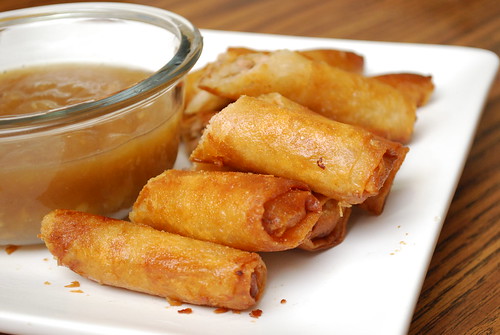
Recent Movies

This is How We Roll...Lumpia Party!

There are some foods that are best made only once in a long while. In my family, one such food is Filipino eggrolls, better known as Lumpia. In fact, it goes beyond making these popular appetizers. My mom especially avoids making lumpia at all costs. Why? Well, for one, it's ridiculously time consuming. It's a production to prep for. It's ridiculously time consuming. It involves so many components which need to be done in a specific way. Did I mention it's ridiculously time consuming?! Despite all that's involved, once they are hot and ready on the table, one bite will leave everyone speechless... and suddenly it all makes perfect sense because it's all worth it and then some.

Earlier tonight I threw a This is How We Roll...Lumpia Party! with friends and family. This is a unique meal event because it's reflective of my Filipino culture. Similar to Mexican culture and tamale making, lumpia is a production to make and involves several components: fillings, wrappers, rolling and frying. There are very many versions to making different types of lumpia and it seems as though everyone has their own tips and tricks of the trade. For this party, my mom, who is now a retired caterer that specialized in Filipino cuisine, took the lead and shared her tips and secrets to making different kinds of her lumpia.
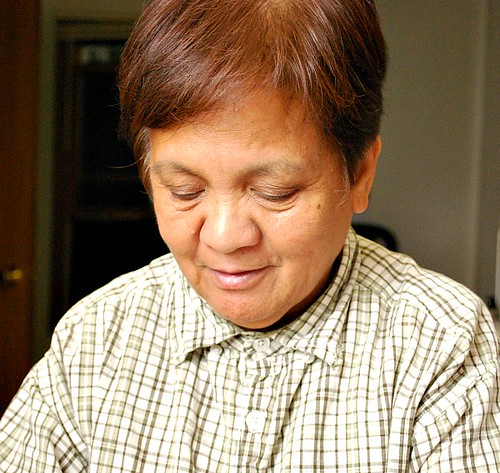
To make my dinner even more special, FoodBuzz is featuring my This is How We Roll...Lumpia Party! for their June 24x24 Food Event. The FoodBuzz's 24x24 Food Event showcases food blog posts from 24 Foodbuzz Featured Publisher bloggers of 24 unique meals occurring around the globe during a 24-hour period. I was thrilled to be featured this month!

  For this party, we made 3 different kinds of Filipino lumpia:

Lumpia Shanghai (thin eggroll bites)
 

Chicken & Vegetable Lumpia (thick eggrolls)

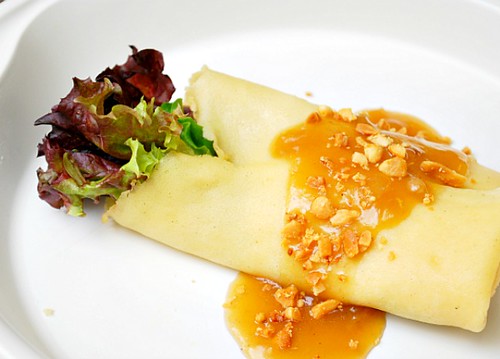
Lumpiang Sariwa (fresh crepe springroll)

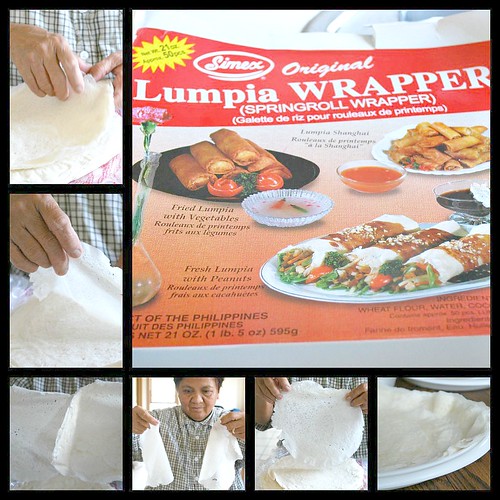
So before we get into the nitty gritty, we need to cover the wrappers. Unlike eggroll wrappers used in Chinese cuisine, traditional lumpia wrappers are much more delicate and thinner. They're almost see through. My mom prefers the Simex brand because it's the original Phillipine lumpia wrapper. These wrappers take a special touch and a whole lot of patience to prepare. They come in a package of 40 and once opened, you'll notice the wrappers all packaged in a stack all stuck together. To use, each individual wrapper must be carefully peeled off from the stack without ripping. When you have the task of prepping the lumpia wrappers, you need to be very patient and careful not to rip or tear these paper thin sheets. Without them, you really can't have a lumpia so it's essential to take your time in handling these. You can find these lumpia wrappers in the frozen section of an Asian market. The package must be defrosted by coming to room temperature before using.
Mom's Tip - Take your time and let the wrappers guide you in peeling. Look for loose edges to determine where to begin peeling the wrappers off one by one. Don't force the wrappers to come apart... just carefully follow the natural way they are stacked. Also, keep a damp tea towel nearby to cover the wrappers you've peeled apart. The towel will help prevent the wrappers from drying out and becoming too brittle to roll with. You'll want to prep the wrappers first by allowing to come to room temperature and save the wrappers as the last component to prep before rolling so that they are used immediately once peeled - which is when they are the most pliable.
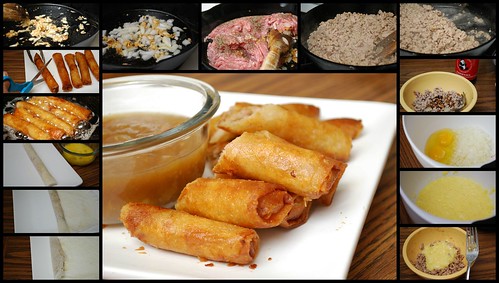
Lumpia Shanghai is a common appetizer at Filipino parties. These are usually expected at any gathering because it's one of those dishes that everyone loves. Lumpia Shanghai are thinly rolled eggroll bites that have a filling of generally pork, beef, chicken, or even shrimp. Some folks make these using a raw filling made with meat and aromatics, which is then rolled, fried and cut into bite sized pieces. My family does things a bit differently where we cook the filling, which is cooled before making the lumpia. Once cooled, wrappers are rolled, fried and cut into bite sized pieces. Here's one of my mom's recipes for Lumpia Shanghai:
2 tablespoons vegetable oil
1/4 cup minced garlic
1/4 cup finely diced onion
1 pound ground pork
1 teaspoon ground black pepper
2 tablespoons oyster sauce
3 eggs
2 tablespoons super finely minced garlic
1 cup super finely diced onion
oil for frying

In a large skillet or wok set over medium heat, add the vegetable oil. When hot, lower the heat add garlic and cook until lightly browned being careful not to darken or burn. Add the onions and sauté until softened and translucent.
Mom's Tip - By slowly browning the garlic in oil, you naturally flavor the oil. Be careful not to burn the garlic - if it's too browned or even burnt, it will give off a bitter flavor in the filling.
Next add the ground pork and black pepper. Turn up the heat to medium high and cook until pork has been browned. Continue cooking the pork until any liquid has evaporated; remove from heat and allow to cool.
Mom's Tip - No need to add salt to the pork. The addition of oyster sauce in the next step will impart the salt in the filling. Be sure to cook the pork until all liquid has evaporated. This will avoid soggy lumpia {due to excess moisture} in the rolling process. Making sure the pork has cooled enough to handle with your hands will also prevent soggy lumpia.
While pork is cooling, whisk together 2 eggs and the super finely minced garlic and onions in a large bowl.
Mom's Tip - Because these are going into the filling raw, make sure the garlic and onions are chopped super fine to prevent large chunks that your guests will bite into.
Add the oyster sauce to the cooled pork mixture; mix to combine. Then add the egg mixture to the pork and combine to create the filling. 
Mom's Tip - By mixing the pork and oyster sauce together first, you allow the pork to pick up on that saltiness of the oyster sauce. The egg mixture is added as a binder. If you combine all of these components together, the pork won't absorb that needed saltiness since it has only been seasoned with ground pepper.
Begin the lumpia rolling process by laying out one wrapper in front of you. Add a teaspoon of filling 1 inch from the bottom center of the wrapper. Carefully fold up the bottom of the wrapper over the filling and roll the filling tightly into a thin log, similar to a thin cigar. Continue rolling the wrapper up until you come up 3/4 of the way. Fold the side edges in towards the middle and continue rolling the wrapper up. When you get about 1/2 inch to the top edge of the wrapper, dab some egg wash over the edge and continue rolling the lumpia and seal.
Mom's Tip - Aim to roll the filling nice and tight to prevent air pockets. If rips and tears occur, do your best to cover them up as you roll. If the ends begin to tear, don't fold the side edges too close.
Continue with rolling lumpia Shanghai until all filling or wrappers are used up. Once done, prepare a pot with oil or a deep fryer. Bring oil up to 350 degrees for frying. Fry a few lumpia at a time.
Mom's Tip - Be sure your oil is at least 350 degrees for frying. If it's less than that, the wrappers will absorb the oil and come out too greasy. If it's more than that, the wrappers will brown faster and the filling will not get warmed through enough.

Once cooked and golden brown throughout, remove from oil and drain on paper towels. Transfer lumpia to a plate and cut into bite-sized pieces. Serve with dipping sauce (recipe follows at the very end).
Mom's Tip - Don't reach for the knife to cut the lumpia! Instead, use kitchen shears - they won't crush the eggrolls like a knife would and it's easier to handle with one hand.
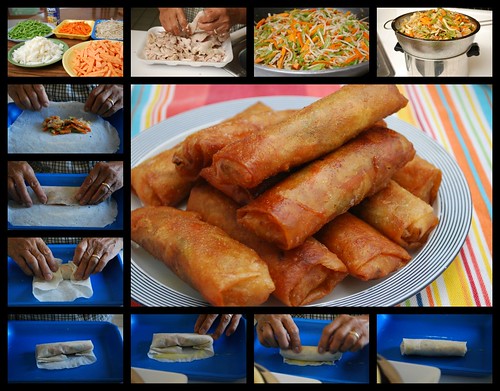
Next up are traditional lumpia.This lumpia generally takes two days to prepare where the filling is made on day #1 and the rolling is done on day #2. For the filling, a combination of green beens, jicama, garbanzo beans or chickpeas, carrots, bean sprouts and yam or sweet potatoes are prepped by cutting in small dice, batons, and juliennes. The myriad of different cuts along with the different textures offer a complex filling that not only taste good but looks good. After the vegetables have been prepped, boneless and skinless chicken breasts are poached in water, which eventually is used later in a dipping sauce. The chicken is shredded and then sauteed with garlic, onions and the prepped vegetables to create the filling. The filling is strained from any liquid given off by the vegetables and cooled completely. The liquid is reserved and is used later for the dipping sauce. Once the filling has been cooled and drained of excess liquid, then it's time to peel apart the lumpia wrappers and get to rolling! Here's one of my mom's recipes for Lumpia Shanghai:
1 pound fresh green beans, julienned
1 can garbanzo beans or chickpeas, drains
1 medium sized yam, peeled and cut into batons
1 pound fresh bean sprouts, end trimmed
1 large carrot, peeled and julienned
1 medium jicama, peeled and cut into batons
1 pound boneless, skinless chicken breast
2 tablespoons vegetable oil
1 large onion, finely diced
1 head garlic, peeled and minced
1 egg for egg wash

Prep the vegetables as noted above and set aside.
Mom's Tip - Don't cut the vegetables too big. Although they are different sizes, they all need to be able to work together in every bite without competing with each other. Once they are combined, they need to form a well incorporated filling.
Meanwhile, place the chicken in a pot and cover with water. Cook over medium high heat and allow chicken too cook through. Remove chicken from liquid and cool completely to handle with hands. Reserve water in pot - do not throw out. Once chicken is cooled, shred by hand into long thin pieces.
Mom's Tip - The reserved water is full of flavor from the chicken and will be used to make a homemade dipping sauce. Shredding the chicken by hand allows you to have more consistent sized pieces. Aim for long thin pieces of chicken so that when incorporated in the filling and used in the wrapper, you'll have a taste of chicken in each bite of the lumpia.
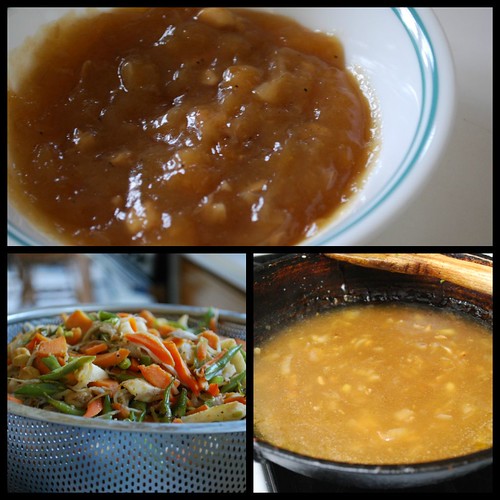
In a large skillet or wok over medium high heat, add the oil. Once hot, add the onions and garlic, sauteéing until the onions have softened and become translucent. Add the vegetables and shredded chicken and cook until the vegetables have softened and cooked though. With a large pot fitted with a fine mesh sieve or colander on top, transfer the filling mixture, allowing any liquid to strain through. Allow filling to strain overnight to capture all excess liquid and moisture.
Mom's Tip - Straining the liquid does 2 things: ensures the filling is dry so it doesn't cause the wrapper to get soggy when filling and rolling; and the liquid is full of flavor that is used to make the dipping sauce. Prepping the filling the day before will allow enough time for the mixture to strain completely.
Begin the lumpia rolling process by laying out one wrapper in front of you. Add a tablespoonn of filling 1 inch from the bottom center of the wrapper. Carefully fold up the bottom of the wrapper over the filling and roll the filling tightly into mini burrito. Continue rolling the wrapper up until you come up 1/2 of the way. Fold the side edges in towards the middle and continue rolling the wrapper up. When you get about 1/2 inch to the top edge of the wrapper, dab some egg wash over the edge and continue rolling the lumpia and seal.

Mom's Tip - Aim to roll the filling nice and tight to prevent air pockets. If rips and tears occur, do your best to cover them up as you roll. If the ends begin to tear, don't fold the side edges too close.
Continue with rolling lumpia until all filling or wrappers are used up. Once done, prepare a pot with oil or a deep fryer. Bring oil up to 350 degrees for frying. Fry a few lumpia at a time.
Mom's Tip - Be sure your oil is at least 350 degrees for frying. If it's less than that, the wrappers will absorb the oil and come out too greasy. If it's more than that, the wrappers will brown faster and the filling will not get warmed through enough.
Once cooked and golden brown throughout, remove from oil and drain on paper towels. Transfer lumpia to a plate and enjoy! Serve with dipping sauce (recipe follows at the very end).
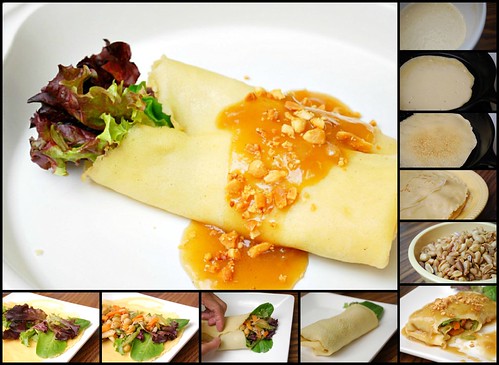
Lumpia Sariwa is the last type of lumpia we made. This is different from the previous two because it doesn't involve the same lumpia wrappers used before. Instead, this lumpia variation uses a wrapper that is similar to a crepe. A thin batter made with eggs, flour, milk, salt and a little oil is cooked on a hot skillet in a round shape. After cooking briefly on each side just like a crepe, the wrappers are stacked and then filled with the same filling as the traditional lumpia and fresh lettuce leaves. It's almost like a cross between a crepe and lettuce wrap with a touch of some Filipino flair. Since the traditional lumpia wrappers are made with wheat flour, I was thrilled to include this lumpia version since I made the crepe wrapper with gluten free flour. It came out delicious and I loved that I was able to get in on the rolling {and eating} action...

Sariwa Wrapper:
2 eggs
1 1/4 cups evaporated milk
1 cup flour {or 140 grams gluten free flour blend}
1 teaspoon salt
2 tablespoons vegetable oil

In a mixing bowl, whisk the eggs and milk together. Add the flour and salt, whisking to combine. Slowly whisk in the oil and set aside.

Heat a 8- or 10-inch nonstick skillet over medium heat. Add 1/4 cup batter to the hot skillet and tilt the pan to distribute the liquid evenly. Cook until the top part of the mixture is dry (about 2 minutes). Using a spatula or your hands, carefully flip over the wrapper to briefly cook the other side. Transfer wrapper to a plate and continue with the remaining batter.

Place the wrapper in a plate then place a lettuce leaf in the middle top part of the wrapper. Spoon the filling and place in the middle of the wrapper (over the lettuce leaf). Close the wrapper by folding the lower part first then roll the sides until the filling is sealed.

Pour the lumpia sauce (recipe follows) over the Lumpiang Sariwa and garnish with crushed peanuts and minced garlic.
Lumpia Sauce

1 tablespoon soy sauce {or gluten free tamari}
reserved liquid from strained vegetables
2 cups reserved chicken stock

1 tbsp garlic, minced
2 tbsp corn starch (diluted in 4 tbsp water)

In a saucepan, come the ingredients except the cornstarch. Allow the mixture to come to a boil. Dilute the cornstarch in water and pour in the saucepan. Cook until the sauce becomes thick. Serve with lumpia either on side or for Lumpia Sariwa, spread over the top and sprinkled with crushed toasted peanuts.

Overall, this was a great party and I loved that my mom took the lead in the kitchen sharing her tips with me, family, friends and now, readers of my blog. There's no doubt in my mind that these are the best eggrolls I'll ever have and I can appreciate even more all the thought, care and effort put into my mom's recipe. I hope you give it a try and my mom's tips are helpful as they have been to me!

Full Disclosure: As part of the Foodbuzz Tastemaker Program,
I received a stipend from FoodBuzz for hosting this event.

Autism Is Genetic Eh? Really?


Autism, it's gotta be genetic, even if we can't see the evidence

No one disputes that autism has a genetic link or links somewhere, now if only we can find it ............  or them.

"Researchers say they have identified gene mutations that contribute to autism in three separate studies. The mutations identified were rare and aren’t necessarily present in the parents, only the offspring, which has made finding them difficult for scientists.     [Emphasis added - HLD]

“It just goes to show how complex the genetic architecture of autism is,” says Thomas Lehner, chief of the NIMH Genomics Research Branch, which funded one of the studies and helped to create the Autism Sequencing Consortium. Together, the studies allow scientists to estimate for the first time that some 500 to 1,000 mutations are likely involved in autism, Lehner tells the Health Blog. Abstracts for the studies, which were published in Nature, can be found here, here, and here. 

The work, conducted by three separate research groups on independent patient samples, also confirms earlier research that older paternal age appears a risk factor for the condition."

Wall Street Journal Health Blog, Complex Genetic Mutations Contribute to Autism, Studies Say

Notwithstanding the lack of any specific identifiable genes directly connected  to autism disorders researchers continue to push their beliefs that autism is primarily genetic.  Actually what they are really saying is autism is a disorder found in humans with different genetic makeups for which .... however ... there is no need to devote research dollars to conducting serious environmentally focused autism research.  After all if man made toxins are involved in any way in causing or triggering autism disorders then presumably corporate profit making ventures could be put at risk.  Better to mention paternal age again and invent a new genetic paradigm to explain why, notwithstanding the lack of any real evidence, we have to believe, we must believe, that autism is genetic.  Profits depend on us being devout in our "autism is genetic" faith.  Oh and by the way autism is not really rising despite changes in estimates, in less than two decades from 1 in 500 to 1 in 88.  

The explanations for the failure to identify specific genes connected to autism are beginning to sound funny.  Or they would be funny if autism research wasn't a serious matter for those who are, or whose children are, severely impacted by autism disorders. 

While parents and researchers calling for more environmentally focused autism research are demeaned or, at best, ignored, the autism research community by and large remains unwavering in its devoutly held faith that autism is, autism has to be, genetic.

The word from the autism research community remains the same: Carry on regardless.  Carry on regardless of whether we see any evidence to support the autism is genetic belief.

Lenovo IdeaPad U310 and U410 Ultrabooks Unveiled

Lenovo Ultrabooks are a game changer. The introduction of the IdeaPad U310 and U410 today marks the milestone where Ultrabooks become mainstream  
U310_metallic gray_hero_02   
IdeaPad U310
Read more »

White Chocolate Strawberry Stuffed Cupcakes

What's better than chocolate and strawberries? White chocolate and strawberries! One of my coworkers celebrated her birthday this week and a little birdie (or two) mentioned how my coworker loves white chocolate, strawberries and vanilla cake. Well, those ingredients easily found their way in these White Chocolate Strawberry Stuffed Cupcakes. Tender French Vanilla cake is stuffed with a fresh strawberry filling and topped with a decadent white chocolate frosting. For a final touch, these cupcakes are kissed with sparkly pink and purple sprinkles to match the liners the cupcakes wore to the party...

It's funny how everyone in my office knows there's a birthday being celebrated when my cupcake tower comes out. This time, it's my friend Michelle who's celebrating a birthday and making these cupcakes were a lot of fun. I used my tried and true go to recipe for french vanilla cake, baked in cupcake form. As for the filling, I used fresh strawberries that I picked at a local strawberry patch. They were small berries but super sweet and made for a great filling. That was one of the most talked about parts of this cupcake in the office! And lastly, the frosting was made with white chocolate that was folded into a traditional buttercream recipe. It's important to use good quality white chocolate - white chocolate chips or candy melts do not work well in this recipe! I also wanted to mention the liners I used. Whenever I bake cupcakes and use cute liners, I always feel a little bummed when the color or pattern of the liner dulls or fades after baking. I recently came across some liners that actually stood up to the baking and retained their color and pattern! Wilton ColorCups are now my favorite cupcake liners because they are a little thicker and the colors/patterns can actually be appreciated. These are foil lined liners with bold colors and patterns. If you spot them at the store, grab them and give them a try. You'll soon convert and pitch those flimsy paper liners once and for all!


 White Chocolate Strawberry Stuffed Cupcakes
cake recipe from Vanilla Garlic

1 cup (2 sticks) unsalted butter, room temperature
2 cups of sugar or vanilla sugar
1 large egg, room temperature
2 egg yolks, room temperature
3 cups all-purpose flour
1 teaspoon baking powder
1 teaspoon of baking soda
pinch of salt
1/2 cup milk
1/2 cup of cream
2 teaspoons of vanilla extract
1 vanilla bean
Preheat oven to 350 degrees. Line 2 (12-cup) muffin pans with cupcake papers. Combine spices in small bowl.

In the bowl of a stand mixer, beat the butter on high until soft for 30 seconds then add sugar. Beat on medium-high until light and fluffy. Continue to add eggs and egg yolks one at a time, beating for 30 seconds between each.

In a separate bowl, whisk together flour, baking powder, salt and baking soda.

Measure out milk, cream and vanilla extract in 2 cup measuring cup. Cut open the vanilla bean and scrape out the seeds and add them to the milk mixture.

Add the flour mixture to the stand mixer bowl, then the milk mixture; alternating between the two and ending with the flour. Mix thoroughly.

Divide the batter evenly among the cupcake tins about 2/3 filled. Bake in oven for about 20 to 22 minutes, turning the pans once, half way through. Test the cupcakes with a toothpick for doneness. Remove from oven and cool completely before frosting.

Fresh Strawberry Fillingrecipe adapted from Good Things Catered

2 pint containers of fresh strawberries
1 3/4 cup water, divided
1 1/2 cup granulated sugar
2 tablespoons fresh lemon juice
1 teaspoon vanilla extract
6 tablespoons cornstarch


In a small bowl, place 1/2 cup of fresh strawberries and set aside.

In a large saucepan, place the remaining strawberries along with 1 1/4 cup of water, sugar and lemon juice. Bring it to a boil and allow to cook, stirring the berries occasionally. They'll eventually break down in about 10-15 minutes. Remove from heat and strain the berry mixture through a fine mesh strainer to remove the seeds. Place the mixture back into the saucepan over medium low heat.

In a small bowl, prepare a slurry by combining the remaining 1/2 cup of water and the vanilla with the cornstarch. Pour this slurry into the saucepan with the strained strawberry mixture. Mix well over medium low heat until it starts to thicken. Remove from heat and set aside to cool completely.

Cut out the middles of each cupcake once cooled. Spoon a teaspoon of filling into each cupcake cavity and the top with white chocolate frosting. Replacing the top of the cupcakes is optional... I choose not to add the tops and just frosting the cupcakes once they were stuffed with filling.

White Chocolate Buttercream Frosting
recipe from Comfortably Domestic
1 cup unsalted butter, softened
3 ½ cups powdered sugar
Pinch of salt
6 oz. good quality white chocolate, chopped (NOT white chocolate chips or candy melts)
¼ cup heavy whipping cream
¼ teaspoon vanilla extract


Put the chopped white chocolate into a small bowl. Heat the chocolate in 30 second increments in the microwave set to 60% power. Stir after each increment, and continue to heat 30 seconds at a time, until the chocolate is melted and smooth. Set aside and allow to completely cool.

In the bowl of a stand mixer fitted with the paddle attachment, add the softened butter. Sift the salt and 2 ½ cups of powdered sugar over the butter. On low speed, cream the ingredients together until light and fluffy, scraping the sides of the bowl as needed.

With the mixer running on low speed, gradually pour the cream mixture the bowl, followed by the vanilla extract.

Add the melted (but cooled) white chocolate until incorporated; increase the mixer speed to medium, and beat frosting for an additional 3 minutes.

Add the remaining powdered sugar, ½ cup at a time, until desired consistency.

Kαρμπόν του 2ου το 3ο Μνημόνιο που ετοιμάζει η τρόικα για τον Ιούλιο


Kαρμπόν του 2ου το 3ο Μνημόνιο που ετοιμάζει η τρόικα για τον Ιούλιο
Δαράτος Γ.
    Βρυξέλλες
    * Η επιμήκυνση της επίτευξης των στόχων κατά 1-2 χρόνια η σοβαρότερη τροποποίηση
    Πολύ μαστίγωμα και μαζί, για παρηγοριά, ένα μικρό καρότο. Αυτή είναι η γνωστή συνταγή που θα εφαρμόσουν για μία ακόμη φορά οι κοινοτικοί μας εταίροι στους Έλληνες, μετά τη χθεσινή ανακοίνωσή τους για την υπογραφή με τη χώρα μας ενός τρίτου, κατά σειρά, Μνημονίου, πιθανότατα μέσα στον Ιούλιο. Δήθεν «νέο» Μνημόνιο, λοιπόν, ύστερα από επαναδιαπραγμάτευση που θα λαμβάνει υπόψη τη σημερινή κατάσταση της οικονομίας μας, προωθούν οι εταίροι μας στην Ένωση.
    Ελάχιστες έως ασήμαντες θα είναι οι κοινοτικές «υποχωρήσεις» και άλλες διευκολύνσεις προς την Ελλάδα, όπως η επιμήκυνση του χρόνου της δημοσιονομικής προσαρμογής κατά 12 ή 24 μήνες το πολύ (2015-2016) και η μείωση των επιτοκίων δανεισμού λίγο πιο κάτω από τον μέσο σημερινό όρο του 3%. Καμιά απολύτως υποχώρηση δεν πρόκειται να κάνουν στις μεταρρυθμίσεις και τις ιδιωτικοποιήσεις, αντιθέτως ζητούν επιτάχυνσή τους.
    «Έχουν ψευδαισθήσεις όσοι ισχυρίζονται ότι το Μνημόνιο δεν μπορεί ν' αποτελέσει αντικείμενο επαναδιαπραγμάτευσης τη στιγμή που όλοι μας γνωρίζουμε ότι χάθηκε, εξαιτίας της πολιτικής κρίσης και των δύο εκλογικών αναμετρήσεων, πολύτιμος χρόνος, κάνοντας τους στόχους των προηγούμενων Μνημονίων εντελώς ανέφικτους» τόνισε χθες ανώτερος αξιωματούχος της Ευρωζώνης.
    Όπως ανακοίνωσε ο ίδιος, η νέα διαδικασία θα αρχίσει αύριο το βράδυ στο Λουξεμβούργο, όπου θα συνεδριάσουν οι ΥΠΟΙΚ του Eurogroup και θα συζητήσουν «πολιτικά» για τις εξελίξεις στην Ελλάδα, συζήτηση που θα συνεχιστεί και στο τακτικό ευρωπαϊκό συμβούλιο κορυφής των Βρυξελλών στις 28-29 Ιουνίου. Στις συνόδους αυτές δεν πρόκειται να ληφθούν ακόμη συγκεκριμένες αποφάσεις, αφού η τρόικα, που θα μεταβεί στην Αθήνα αμέσως μόλις σχηματιστεί κυβέρνηση, δεν θα έχει προλάβει να ετοιμάσει, σε συνεργασία με τις ελληνικές αρχές, το νέο, 3ο Μνημόνιο.


    Τέλη Ιουλίου το 3ο Μνημόνιο
    Η τρόικα θα σημειώσει τα ελληνικά αιτήματα και θα προχωρήσει σε αξιολόγηση της οικονομικής κατάστασης της χώρας και του Μνημονίου προκειμένου να καταγράψει στην έκθεσή της τις αποκλίσεις που υπάρχουν, δηλαδή πού βρίσκεται η οικονομία σήμερα σε σχέση με τους στόχους που της έχουν τεθεί. Η επιδίωξη είναι, πριν από τα τέλη Ιουλίου, να έχει συνταχθεί το 3ο Μνημόνιο για να αρχίσει η εφαρμογή του όσο γίνεται πιο γρήγορα.
    Σχετικά με το αν το ΔΝΤ θα μπορούσε να δεχθεί μια συνολική επαναδιαπραγμάτευση με βάση την πάγια θέση του για τη βιωσιμότητα των εθνικών προγραμμάτων, ο ίδιος εκπρόσωπος απάντησε ότι η θέση του ΔΝΤ δεν είναι ανελαστική, λαμβάνει υπόψη την οικονομική συγκυρία και προσαρμόζεται ανάλογα. Στην αυριανή, μάλιστα, συνεδρίαση του Eurogroup θα πάρει μέρος και η γενική διευθύντριά του Κριστίν Λαγκάρντ.


    Σε ερώτηση για το αν αυτές οι συζητήσεις - διαβουλεύσεις με τους Έλληνες θα είναι εύκολες ή δύσκολες, ο ίδιος εκπρόσωπος απάντησε ότι όλα θα εξαρτηθούν από τα θέματα που θα βάλει στο τραπέζι των διαπραγματεύσεων η νέα ελληνική κυβέρνηση. Για εμάς, τόνισε, είναι σαφές ότι δεν πρόκειται να υποχωρήσουμε στο θέμα των διαρθρωτικών μεταρρυθμίσεων, κυρίως δε για την απελευθέρωση των αγορών, την ενίσχυση της ανταγωνιστικότητας και τις ιδιωτικοποιήσεις, για τις οποίες θα ζητηθεί από την Ελλάδα να επιταχύνει τις διαδικασίες.

    Καμιά αύξηση κατώτατων μισθών - συντάξεων
    Από αυτήν ακριβώς τη δήλωση, λένε καλά πληροφορημένες κοινοτικές πηγές, οι εταίροι της Ελλάδας στην Ευρωζώνη καθιστούν σαφές ότι δεν αποδέχονται με τίποτε οποιαδήποτε ελληνική πρόταση και ιδέα για αυξήσεις κάθε είδους των κατώτατων συντάξεων, μισθών ή και την επιμήκυνση του χρόνου καταβολής του επιδόματος ανεργίας. Η άρνηση αυτή, εξηγούν οι ίδιες πηγές, κρύβεται πίσω από την ανάγκη για «ενίσχυση της ανταγωνιστικότητας» της ελληνικής οικονομίας, για την επίτευξη της οποίας η τρόικα επέβαλε τη μείωση μισθών, συντάξεων κ.λπ. μέχρι σήμερα και προφανώς δεν είναι διατεθειμένη να κάνει πίσω τώρα.
    Με άλλα λόγια, εξηγούν, θα είναι τελείως ανέφικτη διαπραγματευτικά μια ελληνική επιδίωξη της νέας κυβέρνησης για, έστω και τμηματική, ανατροπή του σημερινού εισοδηματικού, μισθολογικού και συνταξιοδοτικού σκηνικού στη χώρα. Το νέο πρόγραμμα και το πρωτόκολλο που θα υπογράψουν όλες οι πλευρές θα πρέπει να οδηγεί στη βιωσιμότητα των δημόσιων οικονομικών και κυρίως σε σημαντικές διαρθρωτικές μεταρρυθμίσεις που θα κάνουν ανταγωνιστική την οικονομία, υπογράμμισε ο ίδιος αξιωματούχος.
    Ως προς την επιμήκυνση της δημοσιονομικής προσαρμογής για δύο τουλάχιστον χρόνια, ο ίδιος απάντησε ότι αυτό θα είναι ασφαλώς ένα από τα ζητήματα που θα συζητήσουμε με την κυβέρνηση μόλις ολοκληρωθεί η νέα αξιολόγηση της τρόικας και διαμορφωθεί μια ολοκληρωμένη εικόνα της κατάστασης και συμπλήρωσε ότι η νέα συνολική συμφωνία θα είναι οπωσδήποτε έτοιμη μέσα στο καλοκαίρι, όχι όμως μέσα στις επόμενες λίγες εβδομάδες.
    Σε ανάλογο μήκος κύματος κινήθηκε χθες και η Κομισιόν, η οποία παραμένει στην ίδια γραμμή απέναντι στην Ελλάδα. Ο Αμαντέου Αλταφάζ, εκπρόσωπος Τύπου του αρμόδιου επιτρόπου Όλι Ρεν, αρνήθηκε να μπει στη λογική των εικασιών σχετικά με το περιεχόμενο του 3ου Μνημονίου εξηγώντας ότι η Επιτροπή περιμένει τον σχηματισμό της νέας κυβέρνησης για να συζητήσει σχετικά μαζί της.


    Υπενθυμίζεται ότι η δυνατότητα συνολικής επαναδιαπραγμάτευσης του Μνημονίου είναι μεν τυπικά εφικτή, αλλά χρειάζεται την ομόφωνη απόφαση των 17 χωρών της Ευρωζώνης. Με άλλα λόγια, μια σειρά από χώρες (Γερμανία, Ολλανδία, Φινλανδία, Σλοβακία, Αυστρία) θα την αποδεχθούν μόνον αν αυτή η επαναδιαπραγμάτευση δεν θίξει τα κεντρικά και βασικά ζητήματα των δυο προηγουμένων Μνημονίων. Και τούτο διότι μια επιμήκυνση κατά δύο χρόνια της δημοσιονομικής προσαρμογής της Ελλάδας θα έχει κόστος για τις χώρες της Ευρωζώνης γύρω στα 16 δισ. ευρώ, τα οποία δύσκολα θα μπορούσαν να δικαιολογήσουν στους ψηφοφόρους και τα κοινοβούλιά τους.
    Ως προς την τόνωση της ανάπτυξης, όχι μόνο στην Ελλάδα, αλλά σε ολόκληρη την Ευρώπη, όπως τη σκέπτεται και θα την προτείνει ο πρόεδρος της Γαλλίας Φρανσουά Ολάντ στο συμβούλιο κορυφής στις 28-29 Ιουνίου, θα έχει πολύ μικρό βεληνεκές, αφού θα αναφέρεται σε ένα επενδυτικό - αναπτυξιακό πακέτο ύψους 120 δισ. ευρώ για όλες τις κοινοτικές χώρες. Από τον κοινοτικό προϋπολογισμό θα προέρχονται τα 55 δισ. ευρώ, από την αύξηση του κεφαλαίου της Ευρωπαϊκής Τράπεζας Επενδύσεων (ΕΤΕπ) και της μόχλευσής του στις αγορές αναμένεται να συγκεντρωθούν άλλα 60 δισ. ευρώ, ενώ τα τελευταία 5 δισ. ευρώ θα προέλθουν από την έκδοση των λεγόμενων «ομολόγων έργου» (μεγάλα έργα υποδομής στους τομείς των μεταφορών, της ενέργειας κ.λπ.).


    Όχι μόνο δεν θα πάρουμε, αλλά θα χάσουμε και 10 δισ. ευρώ!
    Ειδικά για την Ελλάδα, αναμένεται η υλοποίηση της πρωτοβουλίας Μπαρόζο, η οποία επικεντρώνεται στη μεταφορά κονδυλίων από προγράμματα σε δράσεις για την τόνωση της απασχόλησης, την επανεκκίνηση των εργασιών για τους μεγάλους αυτοκινητόδρομους, με την εγγύηση της Ένωσης και την ενίσχυση των μικρομεσαίων επιχειρήσεων. Πρέπει να τονισθεί ότι όλες αυτές οι χρηματοδοτήσεις δεν είναι νέες και οι πόροι προέρχονται από αυτούς που δεν έχει λάβει η Ελλάδα από τα διαρθρωτικά ταμεία (2007-2013).
    Στην πραγματικότητα η χώρα μας όχι μόνο δεν θα εισπράξει περισσότερα κοινοτικά χρήματα, αλλά θα χάσει και ένα μέρος από αυτά που δικαιούται, διότι τα 10 και πλέον δισ. ευρώ που δεν έχει εισπράξει από τα διαρθρωτικά ταμεία λόγω ανικανότητας των κυβερνήσεων της Ν.Δ. και του ΠΑΣΟΚ να συντάξουν και να υποβάλουν συγκεκριμένα αναπτυξιακά προγράμματα θα μπουν σε ένα νέο κοινοτικό ταμείο και θα επαναδιανεμηθούν σε όλες τις χώρες που έχουν ανάγκη από κοινοτικές χρηματοδοτήσεις για την τόνωση της ανάπτυξής τους.

    CHARD, FENNEL AND FETA PIE

    A HEALTHY MEAL AS EASY AS PIE

    “If you knew how to cook, maybe I would eat," Jace muttered. 
    Isabelle froze, her spoon poised dangerously. "What did you say?" 
    Jace edged toward the fridge. "I said I'm going to look for a snack to eat." 
    "That's what I thought you said." Isabelle turned her attention to the soup. 
    - Cassandra Clare, City of Bones, 2007 


    There is a lot of chatter these days around the food blogosphere about from-scratch cooking. The discussion centers mostly around whether or not we, as food bloggers, should be encouraging our readers to try it, should offer recipes simple enough for the inexperienced cook, should expect more than just our fellow food bloggers to want to cook with more than just the canned, boxed or ready-made. Some say that cooking from scratch is expensive, others say it is out of reach of the average home cook, while others say that the concept itself simply scares many inexperienced cooks away. I say it can be as easy as pie.

    I grew up on an odd mix of the pre-packaged, boxed, canned and frozen convenience food of the Sixties and Seventies and home cooking reminiscent of the Old Country. Neither of which prepared me in any way, shape or form for cooking for my own family. By the time we were teens, we often prepared our own meals. And onto college and young adulthood where, as someone who loved food and loved to eat, I experimented with this and that, often very simple, basic fare. But at least I was cooking and eating lots of fresh vegetables. But soon that would all change. No more convenience foods and no more simple cooking for one. I would marry a man who not only was an excellent cook but a man who loved to cook. Weekends, holidays and vacations, whenever he could, he would be the one shopping, in the kitchen, in front of the stove. And he cooked real meals: couscous and brandade, moules marinière and beef stew, poached fish and lasagne. And he taught me to cook. And for twenty some years, I cooked.


    “I am more modest now, but I still think that one of the pleasantest of all emotions is to know that I, I with my brain and my hands, have nourished my beloved few, that I have concocted a stew or a story, a rarity or a plain dish, to sustain them truly against the hungers of the world.” 
    - M.F.K. Fisher 

    From-scratch meals were the only thing that ever found its way onto our table and for several very good reasons. JP would never even consider serving food that wasn’t homemade; it was just what he grew up with and what mealtime was. I took pleasure in chopping and stirring, simmering and baking, and adored bringing the family together around the table for a good, warming meal and talk. And for many years, both in France and in Italy, ready-made or packaged food was scarce. So from scratch it was. But lately, these past couple of years since we moved into this apartment and since the boys have grown up everything has changed. I’ve been complacent – lazy is such a harsh word, isn’t it? – about cooking proper meals what with my husband working from home and doing more and more of the meal preparation and the sons coming and going and never letting us know ahead of time if lunching or dining with us is on the schedule.

    Dinner has been pared down, too often becoming last-minute affairs. These days, we’ll toss together a salad, sometimes simply lettuce and tomato, sometimes a bit jazzier with avocado, rocket, endive, corn and beans added, maybe feta or a can of tuna thrown in, whatever is on hand, and serve it as is with cold cuts (French charcuterie or Italian salumi, if you please), a cheese platter, fresh baguette and a bottle of wine and call it a meal. Or homemade pizza, which we seem to be eating rather often, I have to admit (with a tremble in my voice). “Homemade pizza?” you ask? “Isn’t that rather time-consuming what with the yeast dough and all? How it this simple?” Well, it is my “I can’t think of anything to cook and you all are clamouring for a hot meal” meal. Easy peasy and I can throw together fresh pizza dough with my eyes closed. The rest, I will avow, is jarred sauce, pre-grated mozzarella and whatever anyone wants thrown on top.

    “Oh, I adore to cook. It makes me feel so mindless in a worthwhile way."
    - Truman Capote, Summer Crossing, 1943 


    And there are times, too many to admit to in public, when I simply snip off the top of a box of ready-made soup (yes, box here in France) and heat it stovetop for two or microwave for one. My husband is happy standing up in the kitchen or plopped down on the sofa in front of the news with bread, cheese and a banana. Oh, and a glass of wine, s’il te plaît. When he does, I’ll grab whatever leftovers there are or toss myself a salad or mix a bowl of yogurt, fruit and muesli. We are simple folk and as we get older we are only getting simpler. Sons are old enough and particular enough to grab whatever they want, hot or cold, tossing themselves a salad or boiling a pot of spaghetti. Leaving me only with the dishes.

    And you notice that I am avoiding all questions concerning kabob-frites… rumor, I tell you! Just a bad, sick rumor…

    But then it all implodes. Or explodes, if you listen to my sons raise their collective voice and begin to harangue me, a long (long-winded?) diatribe on my motherly neglect, my laxity in the face of all responsibility, my thoughtless unconcern for the feelings, expectations and, yes, hunger of others. Wow! Well, I admit to myself that I did indeed used to cook a meal almost every night. So, yes, I have been neglectful of my motherly duties, so to speak. And so once in a while I tie on the apron, clear the countertops and sink of dishes and make that grand decision to cook! Oh, you know I am often in the kitchen, yes I am! I bake, bake and bake some more and happy they are with the cakes, cookies, puddings and pies but gladly would they trade half of my production for a savory dish, a one-meat-two-veg meal, a homey casserole, a hearty stew, a steak-salad-potato.


    And so, once in a while I do. I find a recipe that turns me on, I make a list and head to the market. I fill my basket, head home and spend half the day chopping, stirring, simmering and baking. And I love it and I wonder why I don’t do it more often. For, yes, it may be more time consuming than a quick salad, but with the right recipe it is as easy as pie. And everyone is happy.

    I’ve written about my love affair with The Vegetarian Epicure before, two tattered, battered, well-used and well-loved copies, pages stained and torn, brittle and fallen from their binding. I explained about how my husband, knowing just how much I love and use my Vegetarian Epicure book one and book two, had decided to have them rebound yet in the end decided to purchase Anna Thomas’ newest tome instead and offer it to me as a gift of love. All three volumes are filled with luscious, heart-warming, delicious dishes and each and every one I have prepared – many over and over again – arrive at the table perfect. Anna Thomas’ cookbooks are inspiring, trustworthy, reliable and much loved in my kitchen. This recipe is from her latest, The New Vegetarian Epicure. Reminiscent of a spinach and feta Spanikopita, this Chard, Fennel & Feta pie is heartier thanks to a wonderful yeast-bread crust, delicate on the inside, crispy on the top, feather light. Spinach is replaced with chard or kale and lots of onions, garlic and fennel, cooked down and caramelized to a wonderful, smokey, oniony flavour, balancing out beautifully with the tangy, salty feta cheese. I made a few slight changes, which I will give below. Although I made the pie in a rectangular baking dish, I will definitely recommend it being made in a round gratin dish. This way each slice or wedge has the same amount of crust to filling, just the perfect amount; a rectangular dish means some pieces have too much crust and others not enough.


    I am sending this scrumptious casserole to Susan at Wild Yeast for Yeastspotting!! If you love yeast baking or want to learn and improve, then you must visit Susan's blog: she is amazing!

    This is my second pie for Pie Party 2012. Visit the Pie Party 2012 Facebook page to see all the incredible pies made for the party! With my insouciant Dessert First philosophy, I already made a luscious Lemon Chiffon Pie for Pie Day.

    Here are a few other savory pies and tarts I have made that you will love:


    Roasted Cherry Tomato, Feta & Rocket Quiche


    Zucchini Ricotta Feta Tart


    Mushroom & Caramelized Onion Quiche


    Potato, Mushroom & Caramelized Onion Pierogi


    CHARD FENNEL AND FETA PIE
    From The New Vegetarian Epicure by Anna Thomas

    You will need a 13- or 14-inch round gratin dish (deeper than a pie plate); I used a 12 ½ x 8 x 2 ½ - inch gratin dish (pyrex baking dish).

    For the dough:

    1 ½ tsp dry yeast
    1 tsp sugar
    ¼ cup warm water
    3 cups flour
    1 tsp salt
    1 large egg
    2/3 cup low-fat milk
    1 Tbs olive oil

    For the filling:

    3 lbs Swiss chard/kale
    2 medium yellow onions, approximately but not more than 2 cups chopped
    1 to 1 ¼ cup sliced green onions
    2 – 3 cloves garlic, depending upon the size
    1 medium fennel bulb
    2 Tbs olive oil
    1 Tbs cider vinegar
    2 Tbs chopped fresh fennel greens
    ½ cup chopped flat-leaf parsley or coriander (I used coriander)
    Pinch of salt and freshly ground black pepper
    4 large eggs
    ½ cup milk
    10 oz feta cheese
    3 Tbs uncooked white rice (I used basmati rice)

    Prepare the dough:

    Dissolve the yeast and the sugar in the warm water in a small bowl; allow 15 to 20 minutes until it foams and has a thick frothy head. Meanwhile, put 2 ¾ cups of the flour into a large mixing bowl and stir in the salt. Whisk together the egg, milk and olive oil. Once the yeast is activated, stir it into the egg mixture and then mix the liquid into the flour/salt until all of the dry is moistened and begins to pull together into a dough.

    Spread the remaining flour onto the work surface and scrape the dough onto it. Knead it gently, turning often at first to keep it coated in flour, until it is smooth and elastic, 4 to 6 minutes. Form the dough into a ball and place in a clean, lightly oiled bowl, turning the dough until it is lightly coated in the oil. Cover the bowl with plastic wrap and then a towel and set it aside in a warm place to double in size, about 45 minutes to an hour. (I left mine for much longer and it really puffed up but it made no difference; the finished crust was perfect, light with just the right crispy top.)

    Prepare the filling:

    Rinse the chard until thoroughly clean; shake off excess water and pat the leaves dry with a clean towel. Cut off and discard the thick parts of the stems and then coarsely chop the leaves and tender white. Peel and chop the onions. Trim and chop the garlic and the fennel and place them together in a bowl; these will be added to the onion together after the onion has already cooked a bit. Pull off the feathery fennel greens and chop. Chop the coriander or parsley.

    Heat the olive oil in a large pot or Dutch oven; she recommends a very large skillet but I suspect that would be too shallow – you need the deepness of a pot. Add the chopped onion and green onions, stir to coat everything with the oil and sauté over medium heat, stirring almost constantly to keep from burning. When the onions are tender and translucent, about 3 to 5 minutes, add the garlic and fennel. Continue cooking and stirring until all the vegetables are tender and golden, beginning to caramelize. The kitchen should stop smelling like onion and start smelling most definitely of caramel!

    Add the chard to the pot, handful by handful, stirring in each addition until the chard is coated in the onions and starting to wilt. Once it is all in the pan and starting too wilt, add the cider vinegar, the fennel greens and the coriander or parsley, a grinding of pepper and a dash of salt (don’t forget that the feta is salty; you can adjust the seasoning later). Continue cooking until the chard is much reduced and the excess liquid is gone.

    Remove the pan from the heat and allow the mixture to cool somewhat. Once the chard is cooled, separate one of the eggs, reserving the yolk in a small bowl for the glaze, then add the 3 remaining eggs to the white and whisk with the milk. Put the feta in a large mixing bowl and break and crumble it up with a fork. Add the cooled vegetables, the uncooked rice and the egg mixture, blending everything together well. Adjust the salt and pepper if needed.

    Assemble and bake:

    Preheat the oven to 350°F (180°C). Oil the gratin dish.

    Scrape the risen dough onto a lightly floured work surface and punch it down. Divide the dough into two parts, one slightly larger than the other (the larger piece will fit the bottom and sides of the gratin dish, the smaller piece only the top.) Roll the larger piece of dough out to the size of the gratin dish + the sides with a slight overhang and carefully fit into the oiled dish being careful not to rip the dough.

    Spread the filling inside the dough.

    Roll out the smaller piece of dough just the size of the dish. Place on top of the filling, fold the overhanging dough over the top dough, pinch them together to seal and crimp or decorate the edge if you like. Using a sharp knife, make a few slashes in the dough carefully; or you can simply poke some holes in the dough with a fork. Stir the remaining yolk with 1 tablespoon water and brush the glaze over the pie. Bake the pie for about 45 minutes or until the crust is a deep golden brown. Cool the pie slightly before cutting into wedges or squares and serving.

    Conor Misses His So-Called "Segregated" Autism Schooling BUT Summer Helps A Lot


    Conor Doherty, enjoying a summer outing with Dad 
    in Fredericton, the green city.

    In New Brunswick advocates of extreme, everyone in the classroom, inclusion like to describe my son's accommodations as "segration" as though it could be equated with the racially segregated schools of the old American south.  Conor in fact attends a neighborhood school and has ample opportunity to mix with other students, both challenged students in his High School Resource Centre and throughout Leo Hayes High School.  He is well liked and has friends in both the Resource Centre and in the rest of the school. I have often, and I am mean often, seen kids approach Conor with big smiles and greet him.  His instruction, his ABA based instruction, is received in a separate quieter area and he absolutely loves going to school.  Anyone who has worked with Conor in his high school or previously in middle or grade school can confirm these facts.  

    Conor does not receive a "segregated" schooling to use the pejorative terminology of NB's very influential full inclusion activists in the CACL and NBACL.  He receives an evidence based, flexible, inclusive education that accommodates his serious autistic disorder and developmental delay hallenges. Conor loves school. When school ends each year it is a difficult time for him. 

    Summer heat and humidity can cause problems too but we do get outdoors, a lot,  in Fredericton, the green city, which we both love and it helps a lot.  The last couple of days we have done some bridge walking to Fredericton's south side for fresh air, exercise and of course ... treats.  (Conor has a new "walking" shirt, one of Dad's old loose fitting shirts to go over his T-shirts).

    Conor would like to see September arrive quickly, and resume the "segregated" education that Conor loves and some misguided adults demean,  but he and his ol' Dad will enjoy the summer in Fredericton,  this very habitable green city.


    Labels

    أحدث المواضيع

     
    Support : Creating Website | Johny Template | Mas Template
    Copyright © 2013. Entries General - All Rights Reserved
    Template Created by Creating Website Published by Mas Template
    Proudly powered by Blogger